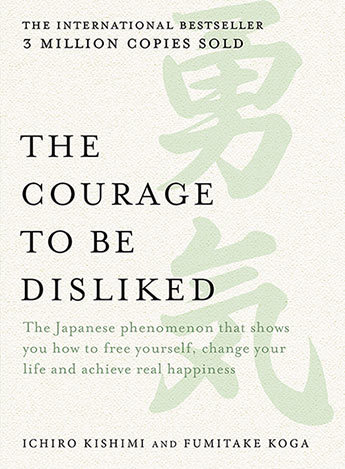
Title: The Courage to be Disliked
Author: Ichiro Kishimi & Fumitake Koga
Series: N/A
Genre: Nonfiction
Rating: 2/5 stars
The Overview: A single book can change your life. Already an enormous bestseller in Asia, with more than 3 million copies sold, The Courage to be Disliked demonstrates how to unlock the power within yourself to be the person you truly want to be. Using the theories of Alfred Adler, one of the three giants of 19th century psychology alongside Freud and Jung, it follows an illuminating conversation between a philosopher and a young man. The philosopher explains to his pupil how each of us is able to determine our own lives, free of the shackles of past experiences, doubts and the expectations of others. It’s a way of thinking that’s deeply liberating, allowing us to develop the courage to change, and to ignore the limitations that we and those around us can place on ourselves. The result is a book that is both highly accessible and profound in its importance. Millions have already read and benefited from its wisdom. Now that The Courage to be Disliked has been published for the first time in English, so can you. -Goodreads
The Review:
What a thoughtful, brilliantly crafted non-fiction book. It was clear a ton of time and effort went into the careful construction of every single argument and counter-argument. Masterful.
I mean, I completely hated it. But it was well done.
I struggled with the formatting – it was a back-and-forth argument between a young boy and an old wise man. I don’t know if it’s this current day and age of people constantly bickering back-and-forth, or just my general dislike of debate class in general, but I had a really difficult time listening to an eight hour audiobook of two people intensely discussing Adlerian theory. In some ways, it read a little condescending because I don’t need a theory argued and disproved beyond all doubt to adopted as useful in my own life. I just want to hear what the ideas are with maybe some real life examples and applications, then I can decide for myself whether or not I think it’s feasible for me. I balk at a format trying to “convince” me anything. It’s too pushy. #rebel
But if I can let the presentation go for a minute, I also didn’t really get a lot out of this book, which surprises me because within a few weeks of each other both my therapist and minimalist/productivity guru Matt D’Avella mentioned how much this book changed their lives. So I was going in with a massive set of expectations and, I mean, I got a few things from it, but not because it explored the topics in any great depth. It was all just surface-level. What I extracted, I did so because I took those surface level ideas in percolated on them for a while, and drew meaning from my inner workings rather than from what was presented in the text. This is not abnormal for a self-help nonfiction, but most that I’ve read offer a bit more topic exploration than what I got here.
That being said, I’m not discounting that this might actually be incredibly helpful for a lot of people, even though it didn’t land for me. I would highly recommend watching D’Avella’s coverage of this book in his video (https://www.youtube.com/watch?v=-DZofD0YN0A). He totally read a different book than I did and managed to thoroughly extract most of the great ideas the book has to offer.
But one gripe – I felt incredibly misled by the title “The Courage to be Disliked“ – because even though that might be the general punchline of the book, it did not spend very much time addressing that specifically. I felt like I should’ve come away with a very clear picture on what it looks like to have the courage to be disliked and how to actively pursue that state of being. I had to read between the lines, and ultimately came away with just the following takeaways:
I liked the idea that to be happy we need to stop seeking validation from outside sources. To take it further, we can tell we are living true to our needs, wants, and desires based on the presence of that outside disapproval. If you’re willing to live in acceptance that people will dislike you, it means you’re being true to yourself.
Another takeaway I liked was this promotion of lateral relationships versus vertical ones. It has universal applications, but I immediately thought of how I could apply it to better raising my kids. I can see how this would help them seek validation from within themselves, rather than always looking at me for approval. Day one applying it has been a success.
And that’s pretty much it.
So overall an interesting read, one that I more or less despised reading. I hope I carry these ideas with me going forward (the true test of a non-fiction), but I fear for me personally this is going to be quite forgettable. Don’t let this review, scare you off of picking up the book if you’re inclined – I seem to be in the vast minority.
Thank you to my Patrons: Dave, Katrin, Frank, Jen, Sonja, Staci, Kat, Betsy, Eliss, Mike, Elizabeth, Bee, Tracey, Poochtee, Kinsey, Alysa, Derek, Kelly, Meabh! <3
by Niki Hawkes
 The Obsessive Bookseller