Image

Book Review: Oathbringer by Brandon Sanderson

Title: Oathbringer

Author: Brandon Sanderson

Series: The Stormlight Archive #3

Genre: Fantasy

Rating: 5/5 stars

The Overview: Dalinar Kholin’s Alethi armies won a fleeting victory at a terrible cost: The enemy Parshendi summoned the violent Everstorm, which now sweeps the world with destruction, and in its passing awakens the once peaceful and subservient parshmen to the horror of their millennia-long enslavement by humans. While on a desperate flight to warn his family of the threat, Kaladin Stormblessed must come to grips with the fact that the newly kindled anger of the parshmen may be wholly justified. Nestled in the mountains high above the storms, in the tower city of Urithiru, Shallan Davar investigates the wonders of the ancient stronghold of the Knights Radiant and unearths dark secrets lurking in its depths. And Dalinar realizes that his holy mission to unite his homeland of Alethkar was too narrow in scope. Unless all the nations of Roshar can put aside Dalinar’s blood-soaked past and stand together–and unless Dalinar himself can confront that past–even the restoration of the Knights Radiant will not prevent the end of civilization. -Goodreads

The Review:

While trying to compose a review that will do this series justice, the question becomes not whether Oathbringer was an amazing installment in the Stormlight Archive series, but how do I explain how fiercely I loved it without gushing like a fangirl? Suffice to say it’s on a pedestal. I can see so many of the brilliant ideas within it shaping fantasy works for decades to come. It truly is the next evolution in the genre similar to that brought on by the likes of Jordan and Tolkien. At least, that’s how I feel about it.

Expansive world building always wins me over, and I can think of very few worlds as impressive as Sanderson’s Roshar. Stormlight Archive is a series that encompasses many different cultures across this island continent. Sanderson provides a constant infusion of these races by highlighting their differences (and celebrating their similarities). This variety of humanity is easily my favorite element. I’ve experienced so many exotic places in this series alone – it truly is a wonder. It is world building like this that makes me ecstatic to be a reader.

I especially loved learning more about each culture through the diverse cast of characters within Bridge Four (even if I am just an “airsick lowlander”). I’ve always loved the characters in this series, but I think Oathbringer is the first book I’ve also appreciated their complexity/duality. They’re definitely not cookie-cutter profiles with mildly interesting back-stories, but deeply flawed individuals with more than just the external conflicts to overcome. If the first two books delved into Kaladin and Shallan’s past, respectively, then book three was an exploration of the events that shaped Dalinar. Even minor characters in this series are rich and interesting, and I eat up  all new information revealed about every single one of them. There were a few new characters that got to share the limelight in Oathbringer (brought in from the interludes in previous books) and I delighted in how they changed the dynamics of the story.

If I’m honest, I’ll admit that there were a few moments throughout Oathbringer where I wondered if the pacing was a little too slow (keeping in mind that I didn’t have a single issue with pacing for the first two 1000+ page novels). It had me considering if it was enough of an issue to take away from my enjoyment of all the other amazing elements. Ultimately, it wasn’t because every time I thought it, something profound would happen to reel me back in. Then the snowball climax of the story hit and all of my hesitations were swept away. The book felt different than the first two, but that doesn’t necessarily mean it was weaker. My friend Liam, over at Thoughts of a Thousand Lives, summed up my internal debate perfectly: “…each of these books is different enough that it’s extremely hard to compare them. All three of them sit pretty equally with me because of that, and the quality of the writing, worldbuilding, and character development never varies at all.”

And that’s the crux of it – all of the things I’ve come to expect from a Sanderson novel were there in abundance. Overall, Oathbringer contained all of the plot advancement and amazing moments I’d hoped to get out of it. Multiply that with the fact that the tome itself is a gorgeous piece of art filled with sketches and diagrams that enhance the story, and you have a reading experience unlike no other. I applaud Sanderson’s ambition and commitment to this project, as I could see how he could have easily wrapped it up in this third book and left a few things unresolved (as many authors have done). What a delight that one of my favorite series on the market continues strong with many more novels to come. If you haven’t ventured into this series yet, you are sorely missing out!

I want to say a HUGE thank you to the publicists at TOR/Forge and Brandon Sanderson for sending me an early copy of Oathbringer for review. You made my year! :D

Other books you might like:

by Niki Hawkes

Image

Series Review [So Far]: The Licanius Trilogy by James Islington


The Licanus Trilogy [So Far]
by James Islington
 4.5/5 stars [for both]

What started out as a seemingly straight-forward classic adventure fantasy quickly evolved into a complex story with countless dynamics and twists & turns. I ended up liking it ten times more than I thought I would – it’s easily one of the best I’ve read this year.

I wouldn’t call this series an “easy” read, as it required more concentration than average, but it’s certainly worth the effort. I don’t pretend I always knew for certain what was going on when some of the time travel elements were introduced, but Islington quickly earned my trust in his ability to tell a good story and reveal things on a need-to-know basis. Instead of stressing about figuring things out, I finally just sat back and enjoyed the thought-provoking and entertaining ride.

The setting shared similar elements with series such as Sword of Truth and the Stormlight Archives, but they were integrated in a way that felt fresh and original. What’s more, I feel as though the author has barely scratched the surface of what this world has to offer in these first two books. I’m always a sucker for such in-depth world building, so I’m cautiously optimistic the third will blow my mind. It’s not just the world building that makes it unique, but also the overall atmosphere. The power plays and dynamics between the heavy-hitters in this series set an almost tangible ominous overtone. It was fantastic.

My only criticisms (which kept the overall rating from a solid five stars) are pretty nitpicky. The end of the first book had a lot of repetitive word choice that was noticeable enough to become distracting, and I think the pacing could have been a tad tighter. The second book had a bunch of flashback scenes which killed the momentum a bit. Even though the flashbacks usually advanced plot and built character, they made the book feel longer. However, what book two lacked in pacing it more than made up for with an absolutely killer ending. At this point I don’t think it’s fair we have to wait a year before the final book. ;P

Recommendations: As the Licanius Trilogy is responsible for some of my favorite reading experiences of the year so far, I’d recommend it to any fantasy reader who isn’t afraid of a slow-burn plot with lots of dynamics. My recommendation is especially strong to those who love the feel of classic fantasy but want something a little more complex.

Other books you might like:

by Niki Hawkes

Image

Mini Review: Magic Breaks by Ilona Andrews

Magic Breaks

Title: Magic Breaks

Author: Ilona Andrews

Series: Kate Daniels #7

Genre: Urban Fantasy

Rating: 3/5 stars

The Overview: As the mate of the Beast Lord, Curran, former mercenary Kate Daniels has more responsibilities than it seems possible to juggle. Not only is she still struggling to keep her investigative business afloat, she must now deal with the affairs of the pack, including preparing her people for attack from Roland, a cruel ancient being with god-like powers. Since Kate’s connection to Roland has come out into the open, no one is safe—especially those closest to Kate.

As Roland’s long shadow looms ever nearer, Kate is called to attend the Conclave, a gathering of the leaders from the various supernatural factions in Atlanta. When one of the Masters of the Dead is found murdered there, apparently at the hands of a shapeshifter, Kate is given only twenty-four hours to hunt down the killer. And this time, if she fails, she’ll find herself embroiled in a war which could destroy everything she holds dear…  -Goodreads

The Mini Review:

Even though I still love this series, Magic Breaks might be my least favorite since the first book. It’s still good, but compared to all the other individual books, it lacked a little magic for me. All of the other installments have a fantastic balance of action, humor, romance, and mystery. As Magic Breaks was the end of the story arc, there was very little room for anything other than action. All of the battle scenes were superbly done, but I missed the other elements to help break it up a bit. There was, however, an especially funny scene at the very beginning (involving a fluffy pet) that might be one of my favorites from the whole series. I wish more of that tone had carried throughout the book. That said, I cannot wait to read the next one!

Other books you might like:

 by Niki Hawkes

Image

Novella Reviews: The Expanse by James S.A. Corey

Whenever I’m tackling a new series that contains novellas as an option, I’m always pestering people to see if they’re worth reading. Some shorts add missing/deleted scenes back into the mix (generally tangents the authors had to cut), while others stand as solid works all on their own as true “bonus” content to the main series. The Expanse novellas definitely fall into the latter category, as most of them have very little impact on the overall arc of the series. Which is not to say that they don’t enhance the series, so I count them solidly in the “worth reading” category.

One of the things I appreciate about these authors is their ability to capture the raw essence of humanity. Motivations, fears, and all the other driving forces behind their actions. These stories will carve out your heart with their earnestness. Vital Abyss and The Churn were the most thought-provoking for me in this regard, but I have to appreciate the raw, relatable emotion in The Drive. I suppose the same is true for Gods of Risk, though I was a little less connected to that one (I did end up appreciating the sum of the whole by the end).

The story with the biggest tie to the series was The Butcher of Anderson Station. Any fan of the series has heard tell of Fred Johnson’s pseudonym and wondered what events earned him the title. This perhaps was the short I was most interested in reading initially, but it was also the one I walked away with the least from, save a little more insight on what drives Johnson’s moral compass.

Of all the works, the most recent one, Strange Dogs, was the most unsettling. It gives me a pit in my stomach on what’s to come in future novels, but at the same time makes me really excited to see where they’re going with the story.

Overall, Vital Abyss was my favorite, but The Churn is the one I’m most excited for people to read. It’s the type of story that leaves a little grit behind, but it was such a fulfilling insight into one of the series’ best characters that it’s a must-read. If you only read one, however, it seems that Strange Dogs, while the most bizarre, might actually have the most impact on the next book, Persepolis Rising… time will tell.

Recommendations: Each of these novellas adds momentum to the Expanse universe with a quality of writing that always knocks my socks off. more great stories from great writers. I wouldn’t call any of these essential to the main series, but they definitely help broaden your perspective. As an added benefit, they’ll help hold you over until the next book comes out.

by Niki Hawkes

Image

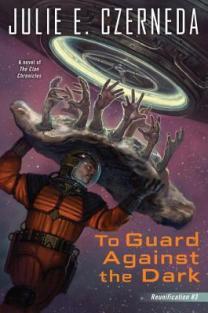
Book Review: To Guard Against the Dark by Julie E. Czerneda

Title: To Guard Against the Dark

Author: Julie E. Czerneda

Series: Reunification #3 [A Clan Novel]

Genre: Science Fiction

Rating: 4/5 stars

The Overview: The final book in the hard science fiction Reunification trilogy, the thrilling conclusion to the award-winning Clan Chronicles.

Jason Morgan is a troubling mystery to friends and enemies alike: once a starship captain and trader, then Joined to the most powerful member of the Clan, Sira di Sarc, following her and her kind out of known space.

Only to return, alone and silent. -Goodreads

The Review:

I laughed, I cried, I loved the journey.

The main things I look forward to in Czerneda’s novels are: awesome aliens, great relationships, and situational humor. To Guard Against the Dark had a perfect combination of all three and, in my opinion, was a fitting way to bring the saga to an end.

Series-enders have a tendency to take themselves too seriously, getting so caught up in building a good story arc that they sometimes forget all the little things that make them special. Czerneda couldn’t have delighted me more with her inclusion of all of my favorite elements (Drapsk, more Drapsk, and Huido) in this novel. It was so much fun! The balance of sentimentality and humor was phenomenal. She got it right. :-) Venturing in, I was worried the story would get too existential, focusing on my least favorite elements of the series, the Watchers and the M’hir (usually represented in the Interludes). Even though those elements played a significant role in the finale (and are the basis behind the entire saga), I found them much less ambiguous than in past novels. Finally we get some answers! 

The publisher is advertising that you can jump right in this series without having read anything else, but in my opinion what makes it special and interesting is that it’s a true merge of stories from her Trade Pact Trilogy (to be read first) and her Stratification Trilogy (which I think needs to be read second even though it’s a prequel trilogy). The whole saga is a great journey with incredibly memorable characters; very well worth reading. I’d recommend it if you like sci-fi that focuses more on characterization and aliens than space exploration, military, and technology (for the record, I like both). My recommendation is especially strong if you like aliens because no one does creature creation better than Czerneda! Side note: I would like a stuffed animal Drapsk for my Birthday, please.

I want to thank Berkley Publishing Group, DAW, and Julie E. Czerneda for a chance to read and review an early copy of To Guard Against the Dark. What a fitting end!

Other books you might like (including more Czerneda):

by Niki Hawkes

Image

Book Review: Yendi by Steven Brust

Yendi by Stephen Brust

Title: Yendi

Author: Steven Brust

Series: Vlad Taltos #2

Genre: Fantasy

Rating: 3/5 stars

The Overview: Vlad Taltos tells the story of his early days in the House Jhereg, how he found himself in a Jhereg war, and how he fell in love with the wonderful woman, Cawti. -Goodreads

.

.

The Review:

If I had to sum up the Vlad Taltos series in one word, it would be: unconventional. The writing voice is all over the place, flitting between past and present, from in-the-moment to addressing the reader directly. It’s as if Steven Brust took one look at the rules of writing and said, “eff those, I’m going to write however I please.” In my opinion, that’s playing with fire, but some of the most poignant writers take those risks all the time (I’m a firm believer that you must know them well first to break them well). There are places where I thought he took it a little too far, and the heavy voice definitely takes a bit to get used to, but his odd writing style is part of what makes the story so interesting.

Brust also throws you in the deep end of this world to either sink or swim, explaining precisely nothing about the dozens of references he makes throughout the story. He will throw in an occasional anecdote here and there, but for the most part you’re on your own. The first 25% of Yendi required a lot more concentration than normal and I didn’t start enjoying the story until I got (mostly) acclimated.

My favorite thing about the series so far is what feels to me like a merging of genres. It’s definitely a fantasy world but it’s presented with a mystery-driven plot and overlay of humor that reads more like an urban fantasy. I will definitely be continuing on. I plan to use this series as a palate-cleanser every time I get sick of the same old stuff.

Recommendations: Venture into this series with a “just go with it” mentality and be prepared for the atypical. I’d hand this to anyone who might appreciate a fantasy/urban fantasy/mystery tale all bundled into one. I would avoid handing it to someone with risk-adverse reading tastes (or people trying to get their feet wet in the genre).

Other books you might like:

by Niki Hawkes