Image

Book Review: A Kingdom Besieged by Raymond E. Feist [+ a series assessment]

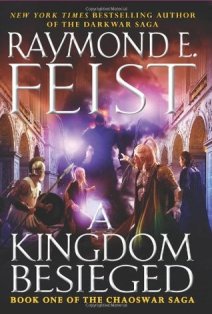
A Kingdom Besieged by Raymond E. Feist

Title: A Kingdom Besieged

Author: Raymond E. Feist

Series: The Chaoswar Saga #1

Genre: Fantasy

Rating: 3/5 stars

The Overview: Midkemia’s fifth and final Riftwar—the devastating Chaoswar—explodes in the opening volume of Raymond E. Feist’s spectacular new epic fantasy trilogy of magic, conflict, and world-shattering peril. A Kingdom Besieged is a breathtaking adventure that brings back Pug—first introduced in Feist’s classic debut novel, Magician, and now Midkemia’s most powerful sorcerer—who faces a major magical cataclysm that forces him to question everything he’s ever held as true and dear…including the loyalty of his beloved son Magnus. -Goodreads

The Review:

The end of the Riftwar world is nigh, and I feel an odd mix of relief and elation. I think the series may be ending with a lot of repeating elements, having been dragged on a little too long… but at the same time, it has been nice to come “home” to the author that sparked my love of fantasy.

I already like the Chaoswar Saga better than the Demonwar Saga. It took a while for things to get going and for all the “players” to be reintroduced, but once it did, it had my interest. Feist included an interesting POV from a creature in one of the demon realms, adding a nice bit of perspective to the overall story, which I’m excited to see develop. Overall, A Kingdom Besieged was enjoyable, containing enough nostalgic elements to keep me interested, but not enough to knock my socks off.

I do have a few critical thoughts about these later works, especially concerning character development. Some of the text practically screams with Feist’s desperate desire to stay relevant and a live up to all the great characters he’s written in previous books. Unfortunately, I think he’s going about it the wrong way – instead of taking the time to develop strong new characters, he shamelessly name-drops. He’s trying to build them up by emphasizing how similar they are to their predecessors, but only succeeds in paling them by comparison, at least in my mind. Here’s a badly paraphrased example:

“Oh, you’re a son of the Duke of Crydee? And an archer to boot!! Look how amazing you are! Why, I’d say you have all the skill and bearings that your great Grandsire, Martin, had. Do you remember how amazing he was?? Splitting-image, I tell you!”

And he doesn’t do this just once, but with every new prominent character we meet. It doesn’t help matters that many of these characters are actually descendant from original characters. I admit I’m at the point where I no longer remember (or care) which generation we’re on.

So, despite a decided quality drop in these later books, I still think (at this point) the series is worth finishing, but the final verdict will be told with the last two Chaoswar books. If you haven’t started this series yet, here’s my recommended reading order:

Riftwar 1 & 2 [2] Loved #1!
The first 100 pages of #2 is a struggle – keep going!

Empire [3] Loved!
Riftwar 3 & 4 [2] Loved!
Krondor’s Sons [2] Loved!
Serpentwar Saga [4] Loved!
Riftwar Legacy [3] Didn’t like…
Conclave of Shadows [3] Loved!
Darkwar Saga [3] Liked.
Demonwar Saga [2] Hated!
Chaoswar Saga [3] The jury is still out…

The Riftwar Legacy is a side trilogy apparently based off of a video game. It lacked the sophistication of the other series and had no particular relevance to future books (that I can remember, anyway). I’d skip those. If the Chaoswar ends well, it MIGHT be worth suffering through Demonwar… I’ll let you know lol. ;)

Other books you might like:

by Niki Hawkes

Image

The Obsessive Bookseller’s Q&A with Anthony Ryan!!

The Obsessive Bookseller’s Q&A with Anthony Ryan!!

First off, I’d like to thank Anthony Ryan for taking the time to answer my questions, and the publicists at Berkley Publishing Group & Daw for making it happen! I was so excited for this opportunity, as Anthony Ryan has quickly become one of my favorite authors. My questions may not be the most original, or even the most compelling, but they are the things I most wanted to know about this author and his Draconis Memoria series. Hopefully you’ll find his answers as delightful as I did. :)


1. Where did you get the idea for Draconis Memoria?

The inspiration for the series comes from a wide variety of sources, but most especially my reading of 19th century history, particularly the economics of colonialism and the industrial revolution.

2. Which character’s perspective did you enjoy writing the most?

In all honesty I like them all equally for different reasons. Lizanne is a lot of fun because she’s always in motion, once she has a goal there’s no stopping her achieving it. Clay has a rouge-ish charm and a particular way of talking that I always enjoy. Hilemore lets me play out my military adventure fantasies, even though I know I’d probably be pretty useless in a real war.

3. How many books will be in the series?

The Draconis Memoria is a trilogy, so one more after The Legion of Flame. The third volume has been written and is with my editor. No decision on what the title will be yet.

4. Do you have any other projects on the horizon?

I’m currently enjoying some downtime but I’m certainly not short of ideas, at the last count there are about fourteen novels in my head waiting to be written. I intend to return to the Raven’s Shadow world at some point, but can’t say when just yet.

5. What does your writing process look like?

I try to stick to a routine as I find forming habits is the best way to ensure a high productivity rate. I start in the late morning by going over the words I wrote the day before which I find useful in ensuring the prose in the first draft is of a decent standard. I then write in 30 to 40 minute sessions throughout the day, drinking a large amount of tea in the process. I usually aim for 2000 words a day but don’t always get there, although for my last book I was averaging 3000 for the final month of writing.

6. Any advice for aspiring writers?

Just the usual: Don’t give up and read a lot. I’d also advise any complete beginners not to get too hung up on word counts. When you’re starting it out it’s more important to concentrate on finishing what you write, however long it takes.

7. Outside of your own, what are some of your favorite books?

I’m a big fan of David Gemmell and his ‘Wolf in Shadow’ is probably my favourite. Robin Hobb is another fantasy author I’ve always admired, particularly her Assassin books. I also read a lot of crime fiction in addition to fantasy, especially James Ellroy, his novel ‘The Big Nowhere’ is brilliant piece of work. Recently I’ve been catching up on Stephen King’s output and thought the Bill Hodges trilogy, which starts with ‘Mr Mercedes’, was terrific.


I still have a US Giveaway running for Waking Fire:

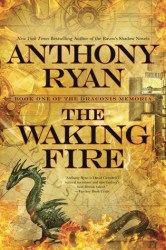
The Waking Fire by Anthony Ryan

The publisher has graciously offered up a paperback copy of The Waking Fire for me to give away to one lucky US resident (I’m very sorry to all of my international followers – you guys are important to me too!). To enter, just take a moment to fill out this rafflecopter giveaway form, and good luck!

a Rafflecopter giveaway
Giveaway Ended – winner has been contacted. :)

US Residents only, please.
I didn’t think this needed to be said, but if you lie about your friendship/following status on any of your entries, all of your entries will be disqualified. #sorrynotsorry
The giveaway will run until Midnight on Thursday, July 6, 2017 MST.

by Niki Hawkes

Image

Book Review: The Legion of Flame by Anthony Ryan + GIVEAWAY!

[June 27, 2017] Legion of Flame by Anthony Ryan

Title: The Legion of Flame

Author: Anthony Ryan

Series: The Draconis Memoria #2

Genre: Fantasy

Release Date: June 27, 2017

Rating: 5/5 stars!

The Overview: Empires clash and a fell power stakes its claim in the second in a new series from the New York Times bestselling author of the Raven’s Shadow Trilogy. For centuries, the vast Ironship Trading Syndicate relied on drake blood—and the extraordinary powers it confers to those known as the Blood-blessed—to fuel and protect its empire. But now, a fearsome power has arisen—a drake so mighty that the world will tremble before it. Rogue Blood-blessed Claydon Torcreek, Syndicate agent Lizanne Lethridge, and ironship captain Corrick Hilemore embark upon perilous quests to chase down clues that offer faint hopes of salvation. As the world burns around them, and the fires of revolution are ignited, these few are the last hope for the empire and for all of civilization. -Goodreads

The Review: 

If you start only one new fantasy series this year, make it Draconis Memoria by Anthony Ryan! I thought The Waking Fire was one of the best books I’d ever read, but Legion of Flame was even better!

Legion of Flame was the ultimate armchair adventure! Each chapter was so good, I had a difficult time finding decent stopping points (and as such, stayed up way too late on too many occasions to finish it). Ryan ended each of his chapters with an aggravatingly brilliant hook that just begged you to keep reading (so I did). There was always an abundance of action, adventure, exploration, steampunk, and, of course, dragons. Every element came together brilliantly for, I’ll say it again, one of the best books I’ve ever read.

In both of these books, Ryan takes you on an exploration of this world and allows you to discover its breathtaking histories/mysteries alongside some very memorable characters. This depth of discovery, combined with a very Indiana Jones adventure feel, is truly the magic of these novels and one of my favorite elements. There’s such a sense of wonder with his world-building – stuff that will truly dazzle you. I can’t even begin to guess what he has in store next!

Both books incorporate multiple POVs and they were all equally exciting to read about. Each character was perfectly placed to give us a grand picture of what’s transpiring, and I triple-dog-dare you to pick a favorite – they’re all deserving of the title. If forced, I’d say Lizanne struck a chord with me the most because her personality has a lot of duality, making her very interesting to read about.

Let’s talk about dragons for a minute. The dragons are incredibly well-conceived in this series. So far, their role has been much stronger than I’d dared hope – it truly is a dragon book. I love the varieties, their importance to the human populations, their significance in the story, and, most predominantly, how well they’re being represented. Ryan manages to keep all the things that I think comprise great dragons while simultaneously amping them up with his own twists. They’re brilliant! And if this wasn’t already one of my favorite books for story, characters, and world-building alone, it would be for the dragons.

So because of the amazing characters, seamless blend of fantasy and steampunk, exciting adventures, page-turning plot, and killer use of dragons, Legion of Flame is perfection. I plan to recommend it as often as I can!

I’d like to think Berkley Publishing Group, Anthony Ryan, and Netgalley for the opportunity to read and review an early copy of The Legion of Flame!


The Waking Fire Giveaway!

The Waking Fire by Anthony Ryan

The publisher has graciously offered up a paperback copy of The Waking Fire for me to give away to one lucky US resident (I’m very sorry to all of my international followers – you guys are important to me too!). To enter, just take a moment to fill out this rafflecopter giveaway form, and good luck!

a Rafflecopter giveaway
Giveaway Ended – winner has been contacted. :)

US Residents only, please.
The giveaway will run until Midnight on Thursday, July 6, 2017 MST.

Other books you might like:

by Niki Hawkes

Image

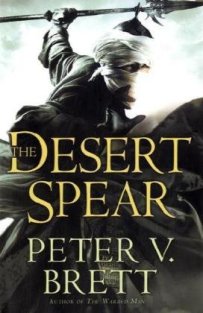
Book Review: The Desert Spear by Peter V. Brett

The Desert Spear by Peter V. Brett

Title: The Desert Spear

Author: Peter V. Brett

Series: The Demon Cycle #2

Genre: Fantasy

Rating: 2.5/5 stars

The Overview: The sun is setting on humanity. The night now belongs to voracious demons that prey upon a dwindling population forced to cower behind half-forgotten symbols of power. Legends tell of a Deliverer: a general who once bound all mankind into a single force that defeated the demons. But is the return of the Deliverer just another myth? Perhaps not.

Out of the desert rides Ahmann Jardir, who has forged the desert tribes into a demon-killing army. He has proclaimed himself Shar’Dama Ka, the Deliverer, and he carries ancient weapons–a spear and a crown–that give credence to his claim. But the Northerners claim their own Deliverer: the Warded Man, a dark, forbidding figure. Once, the Shar’Dama Ka and the Warded Man were friends. Now they are fierce adversaries. Yet as old allegiances are tested and fresh alliances… -Goodreads

The Review:

With every passing week since finishing The Desert Spear, I find myself more and more dissatisfied with it. Something about many of the elements within the story just aren’t sitting right with me, and I’d be the first to state that I’m getting really tired of every other character having a backstory that includes rape, incestuous rape, and sodomy. I don’t know if Brett is trying to make a grander point on who the real “demons” are, or if it just gives him kicks to write about that stuff, but I think it’s too much. Furthermore, it’s not even the sheer volume alone that bothers me, but the forgiving attitude towards the rapists.

And here’s where you’re going to raise an eyebrow at me – I thought a good portion of the book (that following Jardir – whose POV I actually liked more than most) could’ve been a lot grittier. O_o? What Brett says happens in this hostile desert society and what he shows happening were on opposite ends of the spectrum. Not that I want to read about that stuff in detail, but from an analytical standpoint, the inconsistency drove me crazy.

So here I sit, complaining of an issue with subject-matter while also kind of saying that other parts weren’t as graphic as the story required. Do you get an idea of why it took me so long to compose this review? I think the crux of the matter is that, no matter which end of the spectrum I’m considering, I had issues with a lot of things.

That said, and to be even more contrary, I actually enjoyed the process of reading a lot of this book. I find the demons fascinating, and every scene that gave me a glimpse into their true nature provided me that spark I needed to keep reading. I am morbidly curious to see where all the human storylines are going and am hoping to come out of this series with a lot more satisfaction than I got out of The Desert Spear. Now that the story is finally starting to clip forward, I find myself somewhat reaching for the third book… but I may wait a few more weeks to give myself time to simmer down.

Overall, after this mess of a review, all I can say is: I’m enjoying the good elements of the story enough to continue on, but would be hard pressed to recommend it because of all the negative ones. ;P

Other books you might like:

by Niki Hawkes

Image

Book Review: Red Sister by Mark Lawrence

Red Sister by Mark Lawrence

Title: Red Sister

Author: Mark Lawrence

Series: Book of the Ancestor #1

Genre: Fantasy

Rating: 4/5 stars

The Overview: At the Convent of Sweet Mercy young girls are raised to be killers. In a few the old bloods show, gifting talents rarely seen since the tribes beached their ships on Abeth. Sweet Mercy hones its novices’ skills to deadly effect: it takes ten years to educate a Red Sister in the ways of blade and fist. But even the mistresses of sword and shadow don’t truly understand what they have purchased when Nona Grey is brought to their halls as a bloodstained child of eight, falsely accused of murder: guilty of worse. Stolen from the shadow of the noose, Nona is sought by powerful enemies, and for good reason. Despite the security and isolation of the convent her secret and violent past will find her out. Beneath a dying sun that shines upon a crumbling empire, Nona Grey must come to terms with her demons and learn to become a deadly assassin if she is to survive… – Goodreads

The Review:

Red Sister surprised me in quite a few ways. I’d heard a lot about this author’s Broken Empire Trilogy, and much of the hearsay led me to believe I wouldn’t enjoy those books because of difficult subject-matter. However, when the author offered me a review copy of Red Sister, I decided to accept it… with reservations.

As it turns out, I didn’t need any. Red Sister was a really good first installment of The Ancestor series. What surprised me the most was how beautiful his writing and composition was. Very lyrical, but always careful not to overwhelm the story. The same could be said about his world building – it was a subtle integration of details that gradually described the interesting ailments of this world. There were a lot of cool ideas that I can’t wait to see expanded on in the next book.

My favorite part of the story was Nona, the main character. She was such an enigma! As with the world-building, Lawrence revealed bits and pieces about her past as the story went along, and I enjoyed diving into the mystery of it. She was a very compelling character. [Spoiler] highlight to reveal: Nona thought she was a monster, but found a home and friendship with these sisters even though, deep down, she didn’t believe she deserved it. Watching her find a place in this convent and become a cherished member was easily my favorite part of Red Sister – so profound! [End Spoiler]

Red Sister primarily takes place in a convent where the Sisters train on everything from spiritual focus (involving a bit of magic) to hand-to-hand combat. I love school settings as is, but it was cool to read about one in a dark and gritty context. But thankfully it wasn’t too dark, as some of his other works are rumored to be (which I’m sure are still good books, as lots of people really like them. I’m just too squeamish). Red Sister wasn’t nearly as gritty as I was prepared for, containing just enough to make the events realistic and intense without being off-putting.

Overall, Red Sister is a book I’ll be thinking about for a while. I’d recommend it to fantasy readers who don’t mind a little blood and gore. It’s definitely worth your time.

Thank you, Mark Lawrence, for the opportunity to read and review Red Sister. :)

Other books you might like:

by Niki Hawkes

Image

Book Review: The Life-Changing Magic of Tidying Up by Marie Kondo

Title: The Life-Changing Magic of Tidying Up: the Japanese art of decluttering and organizing

Author: Marie Kondo

Series: N/A

Genre: Self-Help

Rating: 4/5 stars

The Overview: Japanese cleaning consultant Marie Kondo takes tidying to a whole new level, promising that if you properly simplify and organize your home once, you’ll never have to do it again. Most methods advocate a room-by-room or little-by-little approach, which doom you to pick away at your piles of stuff forever. The KonMari Method, with its revolutionary category-by-category system, leads to lasting results. In fact, none of Kondo’s clients have lapsed (and she still has a three-month waiting list).

With detailed guidance for determining which items in your house “spark joy” (and which don’t), this international best seller featuring Tokyo’s newest lifestyle phenomenon will help you clear your clutter and enjoy the unique magic of a tidy home – and the calm, motivated mindset it can inspire. -Goodreads

The Review:

I have been an organizer all of my adult life, even going so far as to lists “organizing” as my strongest asset on job applications (as it turns out, all the jobs I’ve ever had have been optimal organizing jobs). 2017 is my year of Simplifying Life, which involves, you guessed it, organizing every aspect. So, when my library flashed an available copy of The Life-Changing Magic of Tidying Up in front of my face, I snagged it… Serendipity? I think so.

This book was fun for a couple of reasons. One of which was that it allowed me to compare my organizing skill set against a professional. I’m delighted to report that I actually came away from it with several new great ideas and a whole new perspective on how to get rid of stuff. The book is packed with many great tips along with an interesting look into how the author developed the KonMari method over the years. Also – it was amazing to finally find someone who can talk about organizing and getting rid of stuff without advocating minimalism! I love stuff. I love MY stuff. I just don’t want to be buried under it.

One of the best things Marie Kondo does is present her method with a clear order of operations for tidying (she uses the word “tidy” in the same way I would talk about organizing and getting rid of stuff). The idea is to ease you into the process by starting out with things that are easier to get rid of. #1 was clothing. This is already a revolution for me, because when I go through my stuff, I tend to always begin with keepsakes – the most difficult things to part with. Anyway, her method involves gathering every like-item of each category in one place. It’s important that you don’t worry about organizing until you’re done sorting items into either keep” or “discard”. One point of contention I’d like to briefly note here is that she advocates throwing things away, whereas I’m more inclined to donate. She does bring up donation as an option, but more often than not describes throwing away dozens and dozens of bags of items).

Her method hinges on 1. using your ability to identify which items bring you joy and 2. your willingness to get rid of everything that doesn’t. This is the part I found most helpful. You see, most other methods I’ve researched advocate identifying which items to discard. Whether it be “get rid of 1000 items over the next year” or “find one item a day to get rid of”. They put more emphasis on quantity over quality that IMO focuses on the negatives. Marie Kondo changed my perspective by conveying that what’s important is not what you discard, but what you choose to keep. With the other methods, it gets to a point where you’re hounding your house, looking for things to discard (I can attest that it can get really frustrating). Kondo has her clients physically touch every item and spend a moment considering whether or not it sparks joy. While her and I don’t agree on every point within her method, this one at least was a home run.

Speaking of not agreeing, the next category after clothing is books… Kondo is of the philosophy that if you buy a book and don’t read it right away, chances are you’ll never get around to reading it and it needs to go. The intention to read a book is not a good enough reason to keep it. BLASPHEMY! Now, I admit I get where she’s coming from, but I think this only applies to the average person and not us book-obsessed. Arguably, books are my life, and when you devour 60+ books a year, there’s a good chance you actually will get to a lot of the titles on your shelves (eventually).

But it got me thinking…

What if getting rid of the books you intend to read in favor of keeping just the books you are excited to read would actually make you feel lighter and more free? On one hand, being surrounded by books is one of my biggest joys in life, but (as any book lever can relate, that looming TBR can cause a ton of stress. I always enjoy what I’m reading, but much less when I’m focused on getting through my current reads because I’m impatient to get to my to-reads.

About five years ago, I had over 4000 books in my house. I don’t remember the exact numbers for the math I did, but at the current rate I was reading, it would’ve taken me over 40 years to get through all of them. Add to that all of the upcoming new releases and all of the hundreds of books on my Goodreads TBR that I have yet to purchase, and we have a problem. Let me repeat: 40 YEARS! How’s that for stressful? So I downsized, getting rid of everything I found only mildly interesting and only keeping the books I thought I’d pay attention to within the next 10 years. As I sit here thinking about all of my favorite books buried underneath mediocre TBR books, I can’t help but think that thinning it out yet once more might not be a bad idea. I definitely don’t condone throwing out most of your books if, like me, reading is your number one joy in life, but I can definitely see the benefit of making your collection something to be proud of. Her method definitely needs some tweaking for us bookish people, and I’ll probably develop some method of my own and talk more about it in my Simplifying Life: Books post coming this fall. Moving on…

Here are some other interesting ideas from this book:

Keepsakes: Kondo suggests going through keepsakes last. That way, you have a good handle and lots of practice using the KonMari method, and can more easily identify which things merit hanging onto. She claims that most keepsakes you don’t actually need to keep because the memories associated with them is already so strong, you won’t forget them after discarding the items. Thinking about my own keepsakes, I can definitely see how this is true – tossing that pile of rocks I have sitting on my shelf from my trip to Wyoming is probably not going to diminish my memory of the trip itself. This will be the hardest category for me because I’m incredibly sentimental about inanimate objects. I learned long ago that if I hold onto it for more than a month, that sucker ain’t ever leaving my house, no matter how trivial it is.

Papers: this is one of the categories I disagreed with Kondo about. She says, aside from a few documents you have to keep like birth certificates and car titles, everything else can be disposed of. I don’t know if it’s a cultural difference, but this woman has clearly never been through underwriting while buying a house in the US. Those people require EVERYTHING. Kondo’s claim is that whatever you discard, you can always get ahold of again if you need it. When disputing charges on my Century Link bill, however, and there bill access section is conveniently not working, that’s when I wish I had a printout of them stashed away. I will admit that the vast majority of papers we hang on to our unnecessary, but for me, the ones I choose to keep are there for convenience and to alleviate possible stress later. It seems like anymore these days the less documentation you have to back you up, the more people screw you over. Or maybe that’s just me. That said, I still only have a small 2-drawer filing cabinet (hot pink, of course) for everything.

Gifts: Kondo does a really great job trying to make you feel less guilty about getting rid of things you received as gifts. We all have them. And we hang on to a lot of them because we’re afraid it would hurt the person’s feelings if we got rid of them. I’m really horrible about this. My mom once gave me a bunch of socks she didn’t like, and I hung on to them for a couple of years before finally asking her if it was okay if I got rid of them. If it comes from my mommy or my husband, it’s really difficult for me to let go, even if I don’t like it. That said, when I do finally let some things go, I feel lighter somehow. Kondo’s argument is that the purpose of the gift was to make you feel appreciated by the gift giver. The item has already served its purpose, and what happens to it after that is the less important factor. I agree completely with that sentiment, and I certainly hope any gifts I’ve given weren’t held onto because of guilt. That said, just don’t let me know that you got rid of it – I gave my grandma a bird statue for her birthday one year and saw it sitting proudly on the table at her following garage sale a couple months later… Ouch.

Stocking up: People buy in bulk and stock up on all sorts of things, and Kondo thinks this is most often unnecessary. Her argument is, by the time you make it through your items, most of them have past their expiration date and have to be discarded, anyway. It’s a much more intelligent use of time money and space to only buy the items as you need them. As I sit here staring at the six boxes of expired peppermint tea that I’ve been buying over the last few years every time I got a coupon, I can totally see her point. I’m going to throw away a ton of tea that I bought on sale, which means I essentially wasted $20 rather than “benefiting” from a savings of $3. There are a few exceptions, but generally, I find her argument to be valid.

Humanizing Items: this is the final thing I didn’t quite see eye to eye with the author on. She says to treat each item like a person (that’s not exactly as she said it, but you get the gist). When you get home from the day and take off your shoes, you’re supposed to thank them for keeping your feet comfy throughout the day. When you get rid of a shirt, you’re supposed to send it off with the thank you for keeping you clothed all those years. I have a couple of issues with this (aside from the obvious). Primarily that doing something like this for every item in your house requires so much energy. I spend most of my day putting on a polite, friendly demeanor for coworkers and tenants, the last thing I want to do when I get to my home – a place where I can let that face down and just exist in peace – is have to treat inanimate objects like they’re people. The more minor issue is that, if I treat my things like people, I’ll never be able to get rid of them without feeling guilty, lol.

To round out the KonMari method, once you have gone through everything in your house and decided what to keep, only then do you start the organization process. The key is making sure everything has a “home.” Right now I have lots of stuff in my house that doesn’t really go anywhere, so it ends up on counters, in cars, and shoved into random drawers. If you give everything a place, then the maintenance of this stuff won’t make you want to peel your face off (that last sentiment is mine, not the author’s).

Overall, as this is one of my first forays into nonfiction (don’t worry, it will be one of my only), I found it highly interesting. The Obsessive Bookseller definitely wants to get her life organized this year, and every little tip helps! I am chomping at the bit to start applying some of the methods I’ve acquired from Kondo to see if they really work, which I’ll definitely highlight it in future Simplifying Life posts (once my house is finished being built and I can dig into all my stuff – currently in storage). In any case, thanks for coming along with me on this organization tangent – I hope you picked up some tips LOL.

by Niki Hawkes