Image

Eight Things Booksellers Would Like Self Published Authors to Know

whoa1

Eight Things Booksellers Would Like Self Published Authors to Know

I was a bookseller for eleven years before injury forced me to find a different career. In that time, I met a LOT of self-published authors and noticed a few areas where my experience as a bookseller could help make their book signing more successful (and make my life easier). Here are some things self published authors might like to know:


1. Making sure your title is available for bookstores to order is an important first step.

Bookstores don’t have access to all titles and, for corporate stores like Barnes and Noble, we can’t sell your title unless it’s in our system and available from one of our distributors. Independent bookstores are much more likely to be able to accept copies you bring from home, but each one is different, so it’s important to do some preliminary research. The more available your book, the easier it will be to make sales.

Recommendation: before setting up a book signing, do research on how to get your title accepted into the bookstores you are considering.

2. Make sure your title is returnable (specifically for national bookstore chains).

With literally millions of titles in publication, it makes sense that real estate in a bookstore is a high commodity. With so many titles vying for space, most bookstores are reluctant to order anything that can’t be returned, especially in the quantities required for a signing event.

Recommendation: if your book has already been accepted into the distribution system, ask how to make your title returnable. I’m told it’s a fairly simple process, but be aware it isn’t a free service.

3. Bookstores typically don’t have a budget to promote your signing event.

The hard truth of the matter is, bookstores are approached by countless self published authors who rarely make enough sales at an event to justify promotional expenditures. Even promotion for New York Times best-selling authors are supported by publishers, the authors themselves (yes, even highly successful authors promote their own events), and social media. There are exceptions to this, but be prepared to handle your own advertising.

Recommendation: if you want people to show up, there are several things you can do – print flyers (or even better, bookmarks) for booksellers to bag-stuff ; ask if you can set up a display a few weeks early with the event info; boost ads on social media; or take out an ad in the paper. The opportunities are there, and go beyond what I’ve listed, you just have to be willing to put in the effort.

4. Take an active role in your signing event.

Most events are schedules for high-traffic days, which makes sense because authors want to engage as many people as possible. From a sales standpoint, booksellers prefer this also. From a logistical standpoint, these days can be so busy that booksellers have a difficult time disengaging themselves from customer service long enough to give your event the attention it needs. Booksellers have the best intentions to set you up for success, but don’t always have the human resources to make it happen. Therefore, the more involved you can be in preparing for and setting up your event, the better.

Recommendation: Promoting your book ahead of time is a great place to start (see #3). Arrive early and help organize your station. Anything you can bring to draw attention to your book is also helpful. I’ve seen authors show up with balloons, stuffed animals, posters, candy trays, and all other sorts of things to attract attention, and the extra effort usually pays off.

whoa25. Your self published book is probably not going to be competitively priced.

In the self publishing industry, there is a noticeable correlation between quality and price. Unfortunately, self publishing facilities don’t have the resources to print at a high enough volume to make the cost per unit competitive. You can sacrifice quality (to a degree) for a lower price, but overall cover appeal plays a role in your book’s marketability. Traditionally published trade paperbacks usually run from $9.99 to $14.99, whereas I’ve seen self published TPs anywhere from $15.00 to $30.00. It’s important to be aware of this disadvantage when asking people to take a chance on your title.

Recommendation: there’s just no getting around the price/volume equation of publishing economics, which is why so many self published authors opt for digital publishing (or poor quality copies). The only thing you can do is consider your market strategy very carefully before going to print.

6. Booksellers don’t want to be hassled about your book.

Meaning: save your soliciting for the customers. We know way more about what’s available to read than the average person and have already decided before we meet you whether or not we want to read your book. Talking about it with us is okay. Pestering us to read it is not. You want to leave booksellers with a general knowledge of your book’s premise, but you also want to leave us with a positive experience. Your goal shouldn’t be to sell to us, but to garner a good relationship.

Recommendation: if you really want booksellers to read your book, provide a free copy a few months ahead of your signing. This gives employees a chance to check out the title with zero pressure and ample time to read it beforehand. This method usually gets the best response, in my experience.

7. Content quality matters.

This, I have found, is the biggest difference between traditional and self published titles. The editing process of big publishing houses is more than just fixing grammar errors and running spellcheck. They invest tons of time and money getting a manuscript ready for market, which is why they’re so picky. They’re only willing to financially back projects they believe will make them the most money. It all comes back to the quality of the content. If you want any chance of standing out in an industry that publishes a million titles every year, recognize that producing quality content is the best way to generate positive word-of-mouth and gain an audience.

Recommendation: “Read a lot and write a lot” (Stephen King). Study your market thoroughly. Attend seminars and workshops. Join a writing group. Acknowledge that your work is not perfect (no one’s ever is) but hard work can make a difference.

8. You are not entitled to an audience.

This seems to be the hardest truth for any author to learn (myself included). Just because you wrote something does not mean others are obligated to want to read it. Literally anyone can self publish a book, but the mere act of doing so doesn’t guarantee you readers. It takes a lot of market awareness and research to produce something with mass appeal. Even if you’ve done your homework, attended seminars, and revised until the red ink ran dry, it still doesn’t entitle you to an audience.

Recommendation: venture into the world of self publishing with a humble approach, a quality product, and rely on positive word-of-mouth and hard work to generate an audience. A sense of entitlement will only hurt your end-goal.


As always, there are exceptions to every rule, but these are the eight things I found true more often than not. At the end of the day, your success rate as a self published author is in your own hands. If this article helped you in any way, my work here is complete. 

by Niki Hawkes

Image

Book Review: The Weaver’s Lament by Elizabeth Haydon

the weavers lamentTitle: The Weaver’s Lament

Author: Elizabeth Haydon

Series: The Symphony of Ages #9

Genre: Fantasy

Rating: 4/5 stars

The Overview: For a thousand years, the lands ruled by the Cymrian Alliance have been at peace. When the brutal death of a dear friend catapults the kingdom to the brink of civil war, Rhapsody finds herself in an impossible situation: forced to choose between her beloved husband, Ashe, and her two oldest friends, Grunthor and Achmed. Choosing her husband will mean the death of thousands of innocents. Siding against him will cost Rhapsody the other half of her soul, both in this life and the next. – Goodreads

 The Review:

“The Weaver’s Lament”, the ninth and final book in the “Symphony of Ages” series by Elizabeth Haydon, takes place over 1000 years after the conclusion of the previous book (“The Hollow Queen”). The first third of the book was an account of how the characters’ lives had progressed over the millennia. It read much like an extended epilogue, which I didn’t mind because I’m always clamoring for more “where are they now?” content at the end of a good series. Even though this catch-up-the-reader storytelling wasn’t particularly eventful, it was enjoyable.

Then Haydon used the remainder of the book to rip out my heart… and I’m still reeling.

I love this series first of all for the characters – it’s one of the few that boasts nonhumans as main POVs, a trait which demands much more creativity on the author’s part. The series also has dragons (which is always a win in my book), and they’re represented in a way I’ve never seen before, so major kudos to Haydon for originality. I also love it for its total immersion into this world’s rich culture and histories. The world is so well conceived it feels like a real place, and I will probably miss the overall “feel” of it more than anything else.

I admit I hadn’t enjoyed the last couple of books as much as I’d wanted to, even though they were good stories. I think the reason might be the multiple perspectives used to tell the tale. For me, the selling point of this series has always been about the Three – Rhapsody, Grunthor, and Achmed. While the other POVs were interesting, they just didn’t bring the same flare to the story. In “Weaver’s Lament”, Hayden recaptured the magic of the series by focusing solely on the Three and bringing their epic saga to an end.

Overall, “Weaver’s Lament” was one of the more satisfying series enders I’ve read in ages. The series as a whole is well worth your time if you like fantasy. Even so, I find it a little difficult to recommend with confidence. The first hundred pages or so of book one are hard to get through (not including the awesome prologue), mostly because it’s a bit confusing and drawn-out. The series also has a ton of story recap and discussion which, while integrated seamlessly, sometimes takes away from plot advancement. Between all of that, however, are moments of pure brilliance which make the whole series worthwhile. All the rehashing might make for a long-winded story, but after reading this series over the course of fifteen years, I can honestly say I remember almost everything about it quite vividly. My recommendation is, if you love fantasy and have a bit of patience, pick up The Symphony of Ages series – it won’t let you down.

Other books you might like:

by Niki Hawkes

Image

Coming soon: Elite by Mercedes Lackey

September 6, 2016

Title: Elite

Author: Mercedes Lackey

Series: Hunter #2

Genre: Teen Fantasy

Release Date: September 6, 2016

The Overview: Joy wants nothing more than to live and Hunt in Apex City without a target on her back. But a dangerous new mission assigned by her uncle, the city’s Prefect, may make that impossible. In addition to her new duties as one of the Elite, Joy is covertly running patrols in the abandoned tunnels and storm sewers under Apex Central. With her large pack of magical hounds, she can fight the monsters breaking through the barriers with the strength of three hunters. Her new assignment takes a dark turn when she finds a body in the sewers: a Psimon with no apparent injury or cause of death…Goodreads

Waiting on Wednesday
Hosted by Breaking the Spine

Mercedes Lackey strikes again!! Hunter is easily one of my favorite YA releases from the last couple of years. It had interesting characters, great action, awesome fantasy elements (with a slight dystopian twist), and a storyline revolving in no small part around competition. I totally devoured it, and have been waiting impatiently all year for the next book. It has been a painful wait, but now Elite is coming out soon and I’m thrilled!

What book are you waiting on?

by Niki Hawkes

Image

Trilogy Review: Agent of Hel by Jacqueline Carey

The Agent of Hel Trilogy
by Jacqueline Carey
4/5 stars

“Agent of Hel” is a trilogy about a half-human, half-demon woman named Daisy, whose heritage earned her the job of liaison between the human world and the supernatural kingdom. It’s a job that gets particularly complicated when citizens start showing up dead by supernatural causes…

Jacqueline Carey is one of my top authors, specifically for her “Kushiel’s” and “Imriel’s” Trilogies (which contain some of the best writing I’ve ever read, although I’d recommend it with a strong disclaimer of sexual content… particularly of the S&M variety). I’ve come to love her for her rich character development, expansive world/culture building, beautiful love stories, and epic storytelling. Many of these elements you don’t normally see within urban fantasies, whose storylines typically revolve around mystery, action, and instant gratification. As you can imagine, after reading Carey’s epic fantasies, I was intrigued to see how she would tackle a new genre.

And the verdict? “Agent of Hel” was anything but typical… And I really dug it.

My favorite things about this series were the world building and quirky cast of characters. Both of which I thought were developed expansively enough to merit more than just a trilogy. Carey’s supernatural world was one of the most conceptual and well-imagined of any I’ve ever read. Everything from creature creation to the political hierarchy went one or two steps above what I would consider necessary for a good urban fantasy. It was a lot of fun. Carey’s characters also had a lot of depth and backstory, but there wasn’t enough time within such a short series to explore them all thoroughly. I wanted more, which is more or less a positive way to finish a series. I don’t think Carey has any plans to write more, but one can dream.

Anyway, despite the series ending before I was ready for it to, “Agent of Hel” had great pacing that kept me engaged from start to finish. It had a nice balance of action, mystery, romance, and humor, which are ingredients for an awesome read.

As with many urban fantasies, “Agent of Hel” contained a prominent romance – one which I thought did a good job of balancing the action without overwhelming the plot. As with everything else, the love story was a bit atypical. For starters, it wasn’t always clear who the love interest was supposed to be. Also, the romantic story arc didn’t follow the usual formula. Both were things I actually liked about the series and, at the risk of sounding redundant, I also found myself craving another book to keep it going by the time the series ended. I should clarify that my slight dissatisfaction was because I was really enjoying what I was reading and wanted more, but Carey did do a nice job wrapping up her plot points with clear resolutions.

Overall, I’d rank “Agent of Hel” as one of the better urban fantasies and would recommend it to anyone familiar with the genre. Fair warning though, the series contains sexual content.

by Niki Hawkes

Image

Book Reviews: The Dresden Files [Books 8-10] by Jim Butcher

The Dresden Files [Books 8-10]
by Jim Butcher

I can definitely see why Jim Butcher is considered a staple in the Urban Fantasy genre – he has an excellent main character (who is a tad whiny at times, but that’s kind of why I like him), loads of paranormal that will continually ding your creep-o-meter (even though I admit it doesn’t take much to set mine off), and plenty of action, humor, and intrigue. Overall, if you’ve never read an urban fantasy, this author is a great place to start. The best thing about him is that he seems to get better with each book.


Proven Guilty

I really liked Proven Guilty, and although it’s been a while since I read it, I still remember quite a bit about it. It sits nicely in a long line of great Dresden books, that’s for sure. This is the novel where you start to get to know Molly – Michael’s rebellious teenage daughter (and a character I quite like). The coolest part about this book is the plot: Molly and her boyfriend get mixed up in a phenomenon of horror movies brought to life. Dresden, as usual, has to figure out what’s going on. It was a mystery I enjoyed watching him unravel. Overall, a solid installment.

4/5 stars


White Knight

White Knight was my least favorite of the series so far (of the latter books, anyway… the beginning of the saga started out admittedly rough). That is, however, until I started writing this review. You see, the book as a whole was actually comparably good. The culprit for my dissatisfaction was a single, prolonged dream/alternate plain of existence scene right in the middle of the book that took me out of the action and added absolutely nothing to the plot. It was weird. Had it not been included, I’m sure I’d be sitting here praising White Knight with the same enthusiasm as the rest, but that one scene managed to leave the taint on the whole thing. Aside from that, the book was actually pretty entertaining – containing a mystery surrounding Thomas (whom I love), and a few hilarious moments. If you read it, just skip that weird part and all is good.

3.5/5 stars


Small Favor

I actually liked Small Favor a lot. Like, enough that it may be my favorite of the series. Here’s where I have to admit that I’m composing this review way after reading the book and have already ventured on as far as book 14. It’s still my favorite so far… mostly because, in a long series where individual story lines start to blend together, I can still remember with vivid clarity everything that happened in this book. It had a great conflict right off the bat (a good start), and ended with one of the coolest battle settings so far (a good ending). Not to mention it was funny as shit. Consider book 10 Obsessive Bookseller endorsed.

4.5/5 stars


If you haven’t picked up a Dresden book yet, just know you’re in for a well-conceived and sustainable series, jam-packed with scary monsters and a lot of snark. I consider them a must-try for any fan of the genre.

Other books you might like:

by Niki Hawkes

Image

Book Review: Hyperion by Dan Simmons

Hyperion by Dan Simmons

Hyperion by Dan Simmons

Title: Hyperion

Author: Dan Simmons

Series: Hyperion Cantos #1

Genre:  Science Fiction

Rating: 3/5 stars

The OverviewOn the world called Hyperion, beyond the law of the Hegemony of Man, there waits the creature called the Shrike. There are those who worship it. There are those who fear it. And there are those who have vowed to destroy it. In the Valley of the Time Tombs, where huge, brooding structures move backward through time, the Shrike waits for them all. On the eve of Armageddon, with the entire galaxy at war, seven pilgrims set forth on a final voyage to Hyperion seeking the answers to the unsolved riddles of their lives. Each carries a desperate hope—and a terrible secret. And one may hold the fate of humanity in his hands.

The Review:

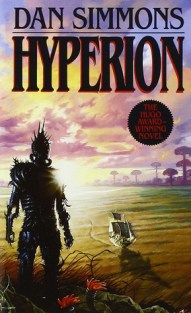
“Hyperion” was an interesting book, but it’s difficult to convey what the story was about in a summary. It’s one of those books that gradually reveals its purposes as the plot progresses. In a nutshell, a handful of POV characters journey to Hyperion – an enigma of a world made even more mysterious by the presence of the Shrike (see cover for visual – it’s the big metallic being). As each character expands on their connection to this world, you start to get a sense of what’s really going on.

“Hyperion” is definitely a thought-provoking book. Although it started out with heavy religious overtones (the first perspective being the religious POV), it soon captured my imagination with a complex mystery and only got more engaging from there. It was not a feel-good story. It was the kind of gritty, morbid tale that kept me page-turning well into the night despite the ever growing knot in my stomach. Then it kept me up even longer as my brain tried to sort out all the information learned about this world, the Shrike, and their effects on time itself. It’s ironically exhausting… and kind of brilliant.

Time manipulation in stories is a tricky thing. It can go from a clever idea to convoluted in a heartbeat. I often  find myself finishing such books or shows slightly confused, wondering if I missed a critical detail somewhere or if the author just failed to communicate it clearly (it’s usually a bit of both). In “Hyperion,” Simmons did a decent job of presenting his concept in segments which were easier to digest. In fact, his overall presentation of all pertinent information was very carefully placed and effective. It allowed me to build my own theories alongside the characters based on every new revelation. That’s the sort of engaging interaction I always enjoy within books. Overall, it’s one of the better conceptual time-manipulation novels I’ve ever read.

Another note in “Hyperion’s” favor was its timelessness. It was written when I was 4 years old (O_o) yet read as though it was written within the last couple of years (and will likely do so for many to come). It illustrated just how smart Dan Simmons is at story construction. Surmising from just the text, Simmons comes across as a very well read, intelligent person. It was awesome to pick up on all the literary references throughout the plot, and I’ve always been impressed with authors who can present POV characters with such integral differences in perspective on complex issues such as religion and politics, and do so convincingly. I have no idea where the author’s personal stances are on these issues, and that something I oddly love about his writing.

I can  easily see why classic sci-fi lovers rave about this book and defend their 5 star ratings to the ends of the earth. My conservative 3 star rating, however, hopefully conveys appreciation for the book while acknowledging that it didn’t quite blow me away on all accounts. I think the culprit might be the fact that there’s no silver lining or hope in this book. It definitely doesn’t leave you with anything but gloom and that aforementioned knot in your stomach. Now, I don’t need books to be about butterflies and rainbows to enjoy them, but I do need at least a tiny ray of sunshine to give me hope that the story could end well and that the characters are working towards something meaningful. Part of this can be attributed to the format of this first book – the multiple POVs were presented in a reflectional format where all the focus was on what came before. While interesting, it didn’t leave a lot of room for plot advancement, and in fact made  most of the book read like a collection of prequel novellas leading up to the actual beginning of the story.

Overall, I liked “Hyperion” but it didn’t land among my favorites.  It is still an awesome contribution to classic sci-fi and worth your time if you like the genre.

 Other books you might like:

by Niki Hawkes