Image

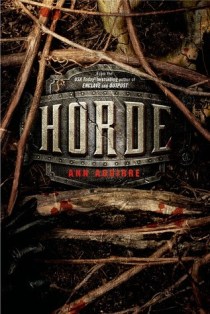
Book Review: Horde by Ann Aguirre

HordeTitle: Horde

Author: Ann Aguirre

Series: Razorland #3

Genre: Teen Post-Apocalyptic

Rating: 4/5 stars

The Overview: The horde is coming.

Salvation is surrounded, monsters at the gates, and this time, they’re not going away. When Deuce, Fade, Stalker and Tegan set out, the odds are against them. But the odds have been stacked against Deuce from the moment she was born. She might not be a Huntress anymore, but she doesn’t run. With her knives in hand and her companions at her side, she will not falter, whether fighting for her life or Fade’s love. Ahead, the battle of a lifetime awaits. Freaks are everywhere, attacking settlements, setting up scouts, perimeters, and patrols. There hasn’t been a war like this in centuries, and humans have forgotten how to stand and fight. Unless Deuce can lead them. This time, however, more than the fate of a single enclave or outpost hangs in the balance. This time, Deuce carries the banner for the survival of all humanity.

The Review:

This is the final book in the Razorland trilogy, and I have to say it was a really good series-ender. I was oddly fearful to pick it up and even stalled for a full year because I was worried it wasn’t going to like it. I’m not sure where that irrational fear came from because it’s no secret Aguirre is one of my top authors. Whether it’s a post-apocalyptic zombie story, a science fiction about an alien prison (The Dred Chronicles), or new adult romances (The 2B Trilogy), Aguirre consistently delivers books that I absolutely love with her great writing, amazing characters, and fun storylines. I think my hesitance with Horde was that I couldn’t really see the vision on where the story was headed. In addition, there were a few gruesome (in concept, not detailed in writing) scenes in Outpost that left me a bit sickened and depressed after reading them (I know, I’m a weenie).

Either way, when I finally did read it, I really dug it.

I think horde was just as conceptually disturbing, but I must have been in a much better mood to read it because I devoured it. I also appreciated where Aguirre took the story – finally giving me some answers behind how the “muties” emerged, which also allowed me to finally understand why she was vehemently offended that people referred to them as zombies… an attitude I find a little strange considering she never really describes their origins until the 3rd book. Anyway, it ended up being rather thought-provoking, which I liked.

One of my favorite things about this series was the way the author incorporated all the different humans subcultures in this post-apocalyptic world. She had everything from gangs to religious zealots, and I thought they all added a different wrinkle of perspective to the story. None of it was ironic, and really made the story seem more realistic. I also especially loved Deuce – the main character. She had a lot of conviction, and within all of these different subcultures still managed to adapt and make the best out of each situation (which is why I named her “most adaptable” in my Top Ten Female Characters That Inspire Me! post a few years ago). The Razorland Trilogy might not be my favorite work from Aguirre (which is only a solid 4-stars), but Deuce is easily one of her best characters. I know Aguirre has another series planned for the same world (the first book is called Vanguard, and I think it comes out sometime in early 2017), and I really hope Deuce makes at least a cameo appearance.

Although I really liked Horde, the characters do an awful lot of traveling, which got a bit repetitive. Honestly, I don’t know how else the author could have progressed the plot to where she wanted it to go without all the back and forth, but pacing suffered a little bit. Also, when I think of the word “horde” I think a plethora of creatures too numerous to count… not a group of creatures numbering a couple thousand (:/). So in that regard, the overall story conflict felt a lot more narrowly focused than I thought it was going to. It was still good, mind you, it just didn’t escalate to the level that some other books in the genre have. Arguably though, the logistics for this post-apocalyptic story were a lot more realistic, so I guess there’s your trade-off.

Overall, I’m really glad to have read this series and am excited to see what Aguirre does with it next.

Recommended Reading: I would suggest the Razorland Trilogy to people who love zombie stories and teen books with an edge. Even though I’m not fully on the zombie bandwagon, I think others who are would really enjoy Aguirre’s take on them (even though they’re not technically zombies… close enough to count though).

Other books you might like:

by Niki Hawkes

Image

Trilogy Review: Penryn and the End of Days by Susan Ee

Penryn and the End of Days Trilogy
by Susan Ee
3/5 stars

The “Penryn and the End of Days” Trilogy is a post-apocalyptic young adult series about vengeful angels who have destroyed most of humankind. Penryn, a teen with a crazy mother and crippled sister to take care of, struggles to help her family survive. When her sister is abducted, Penryn will do anything to get her back, even if that means working with an angel…

Overall, I found the concept and execution of this series incredibly original. In a market flooded with post-apocalyptic/dystopian titles (many of which I’ve read… they are addicting), finding something unique seems to get increasingly difficult. This series was definitely unlike anything I’ve read before.

The first book “Angelfall” was a solid five-star read, and I loved it so much I gushed about it for weeks. In fact, here’s the review I posted shortly after finishing it:

I haven’t been so excited for the beginning of a post-apocalyptic series since I picked up Partials by Dan Wells two years ago… and trust me, I’ve read a LOT of books from this genre between then and now. Angelfall just had an X-factor that immediately grabbed my attention and held it from start to finish. So much so that a hundred pages into the first book I was already online ordering the next two in the series. It was one of those books that made me a believer early on, and I’m kicking myself for not picking it up sooner.

The biggest thing that stood out to me about Angelfall was how incredibly well it was written. Susan Ee has a way with words and descriptions that allowed me to completely lose myself in the story. All of the interactions between her characters seemed so organic and natural, and that’s part of the reason why I think the book flowed so well. For everyone I’ve ever heard complain about insta-loves in YA, this would be an excellent series for you – the relationship development in Angelfall was gradual, based on shared experiences between the characters and a combination of little moments… i.e. my favorite kind of love story.

The other thing that stood out was the concept and how it was executed – this is a post-apocalyptic world where angels (of all things) are responsible for its destruction. Now, up until this point I haven’t had any interest in the angel trend permeating the YA market because it always seems to come across a little cheesy (as it did occasionally in Daughter of Smoke and Bone). What Ee managed to do was take all of the traits indicative to angels and make them kind of badass. The creatures in her novel were dangerous, and you could feel that deadly force emanating from the pages with each new conflict. It was awesome. And if the great concept wasn’t enough, add to that heart-wrenching back story to Penryn and her family (which added a ton of interesting depth and dynamics the story) and you have one robust, well-rounded novel that is sure to knock your socks off.

It was as remarkable to me as any other first-book staples of the genre like Hunger Games and Divergent. It was original (see above), fast-paced (I haven’t been so engaged in a teen book in ages), and contained one of the most organic romantic relationships of any teen series I’ve ever read. In a genre famous for its “insta-loves” finding a relationship that develops naturally was a treat, and quite possibly my favorite element of the story. Those positive elements remained true for the following two books in the series…

But beyond the first book, conceptually, she lost me.

The first book promised to take a plethora of interesting directions, all of which were compelling. But after finishing the series, I never felt as though it lived up to its potential. As I’ve mentioned, I’ve read quite a few teen dystopian/post-apocalyptic novels over the years, and the motto I adopted from them is question everything. I initially went into the “Penryn” Trilogy skeptical if the destructive angels were in fact actually divine beings, or if they had some other, more earthly, origins. I feel compelled to save other readers the same frustration by disclaiming: my questions regarding that were never answered. And in fact, I finish the series with most of my questions and theories unanswered, which is one of the reasons I feel the story was somehow incomplete/inconclusive even though it was entertaining.

Overall, I don’t regret reading this trilogy because it really was a breath of fresh air in the genre. The first book was easily the best of the three and still one of my all-time favorites despite my lower rating of the final two books (2.5 stars, or aka – I liked them, but I didn’t really like them). What can I say? The first book set such a high standard it would’ve been difficult for anything else to compare.

Other books you might like:

by Niki Hawkes

Image

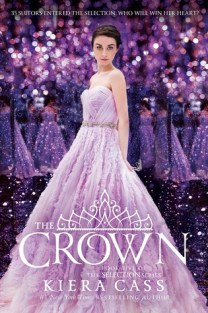
Book Review: The Crown by Kiera Cass

Title: The Crown

Author: Kiera Cass

Series: The Selection #5

Genre: Teen Fiction/Dystopian-ish

Rating: 2.5/5 stars

The Overview: When Eadlyn became the first princess of Illéa to hold her own Selection, she didn’t think she would fall in love with any of her thirty-five suitors. She spent the first few weeks of the competition counting down the days until she could send them all home. But as events at the palace force Eadlyn even further into the spotlight, she realizes that she might not be content remaining alone. Eadlyn still isn’t sure she’ll find the fairytale ending her parents did twenty years ago. But sometimes the heart has a way of surprising you…and soon Eadlyn must make a choice that feels more impossible—and more important—than she ever imagined. –Goodreads

The Review:

As a whole, I’ve had a TON of fun reading this series. It has that magical “it” factor that made me love the awesome moments with unparalleled ferocity while conveniently ignoring its rather glaring shortcomings… up until The Crown, anyway. Despite my love/hate relationship with this final book, I am genuinely sad to see the saga come to an end.

Before picking up The Crown, I read a review from a fellow blogger who bluntly called the book “silly.” I found myself bristling immediately – how dare she call any part of my favorite series silly? I mean, it’s not perfect, but there are so many amazing moments that surely it deserves better than that!

And then I read The Crown, and… I agree. The book was a bit silly.

As with the first three Selection books, the brilliant bits came pretty loaded up front with each girl’s story. The Selection was easily the best of America’s stories, and The Heir was the best of Eadlyn’s. While The Heir focused primarily on the romance and Eadlyn’s relationship with the boys (which is the magic of the story), The Crown focused more on politics, world building, and broader conflicts – all elements I’ve never thought the author handled particularly well. The relationships and interpersonal interactions are what make her series so special, and I found myself constantly wishing for the focus to turn back to them throughout. It left me wanting. Hard.

I don’t usually rant in my reviews, preferring to be more professional and subjective, but I’m feeling sassy today, so here goes… Also: Spoiler Alert!

Before I dive into why I found the final book so eye-rolling, let’s have some boy talk! My vote was for Erik to win right from the start, mostly because the relationship was organic and unforced, but also because Kyle seemed too obvious a choice. So, needless to say I’m satisfied with that outcome, but did every other relationship have to get wrapped up so conveniently? Come on! Where’s the conflict? One of them was gay, one of them wanted to pursue other things, one of them was suddenly afraid to be king, and one of them bowed out nobly so his friend could have the girl – there seemed to be perfect little solutions for every relationship. Even in amped-up competitive relationships, that’s just not how things work. I mean, have you seen how many rejected people on the Bachelor bawl their eyes out on camera after being sent home? Rejection hurts, and in a competitive setting like the selection, people don’t usually volunteer to “lose.” I think the contestants’ exits could have been a bit more dramatic had the author made the relationships the primary focus of Eadlyn’s struggles. Instead, she focused on a conflict with a bogus wannabe king and her dreaded lack of positive public opinion (get over it already!). I think it’s clear that I feel The Crown focused on all the wrong things.

And maybe it would have been okay had those other things been done well… 

I have such a hard time buying into a king and queen (specifically, America and Maxom, whom I thought I knew pretty well) being totally okay passing the weight of the kingdom onto an adolescent’s shoulders just so they don’t have to worry about it anymore. First of all, I never got the impression they were that irresponsible or selfish throughout America’s story. Second of all, that’s just not how things work. There’s no way the infrastructure of a royal house would allow for the royals to decide they just don’t want to do it anymore. It would garner way too much instability. I’ve heard of royals dying prematurely, by nefarious means or otherwise, but I’ve never heard of them quitting. Sigh… Cass’s world, Cass’s rules, I guess. It just didn’t scream well-thought-out to me. And don’t even get me started on the citizen “meetings”… ugh. And, to beat the horse to death, she didn’t have to fill the pages with all of those senseless conflicts if she’d just kept the focus on the romance. This is one of those books I’m rewriting in my head for sanity’s sake.

Anyway, it’s clear I’m a mixed bag of feelings with this last book, leaning more towards negative than positive. In all of the past books, I overlooked the things that could have been bothersome because I was enjoying all the other bits so much. In regards to The Crown, there just wasn’t enough magic to keep me occupied, so I got annoyed. The only reason for the somewhat decent rating is that I liked Eadlyn’s relationship with Erik. Overall, I will look back on this series with a mixture of adoration and frustration, but I just might try to forget how some things ended in The Crown.

 Other books you might like:

 by Niki Hawkes

Image

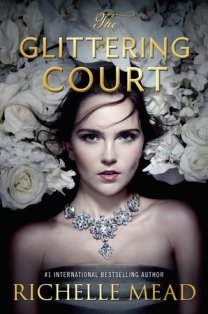
Book Review: The Glittering Court by Richelle Mead

The Glittering Court by Richelle Mead

Title: The Glittering Court

Author: Richelle Mead

Series: The Glittering Court #1

Genre: Teen Fiction

Rating: 4/5 stars

The Overview: Big and sweeping, spanning from the refined palaces of Osfrid to the gold dust and untamed forests of Adoria, The Glittering Court tells the story of Adelaide, an Osfridian countess who poses as her servant to escape an arranged marriage and start a new life in Adoria, the New World. But to do that, she must join the Glittering Court. Both a school and a business venture, the Glittering Court is designed to transform impoverished girls into upper-class ladies who appear destined for powerful and wealthy marriages in the New World. Adelaide naturally excels in her training, and even makes a few friends: the fiery former laundress Tamsin and the beautiful Sirminican refugee Mira. She manages to keep her true identity hidden from all but one: the intriguing Cedric Thorn, son of the wealthy proprietor of the Glittering Court.

The Review:

Richelle Mead has been one of my top authors for several years now, and I’m pretty sure I’ve read all of the 25+ books she has on the market to date. Most people know her for her YA “Vampire Academy” series, which is ironically my least favorite of her works even though I still enjoyed it (until it hit book #4, then it was pure magic). No, I very much prefer her urban fantasy “Georgia Kincaid” series or even “Bloodlines” – a spinoff to the “Vampire Academy.” Specific series aside, I can claim with confidence that Richelle Mead has never let me down, her books always ranging from “really good” to “omg, this is one of the best things I’ve ever read in my entire life.”

“The Glittering Court” (so far, at least) drifts closer to the “really good” category.

It’s much different than anything she’s done to date, but still had excellent, well-developed characters, great pacing, and an entertaining storyline. The basic premise involves an establishment that teaches eager young women to become proper noblewoman for the purpose of being sold as brides newly settled land across the sea. The main character, a young countess of a failing household, sees the Glittering Court as an opportunity to escape the obligations that bound her life and start anew. And then the fun begins!

The whole book was a delightful read, especially the portions that took place in the Glittering Court, which reminded me fondly of “The Selection” series by Kiera Cass – one of my all-time favorites. The remaining portion had a very alternate-history feel that seemed almost interchangeable with England’s colonization of “The New World.” It’s rustic frontier atmosphere was a stark contrast to the earlier glitz and glam. Oddly enough, all of these elements worked really well together and I liked the wide variety it had to offer.

Overall, it was highly entertaining from start to finish. I’m not sure I’m totally excited about where the story is headed next (The Glittering Court itself being my favorite element from this book), but I trust Richelle Mead enough to be confident that it’s going to be fabulous, whatever direction it takes. Mead has this brilliant way of building incredible momentum throughout her series, escalating everything to a point where you’re simply breathless, exhausted, and elated by the end. I can’t wait to see if she does the same with “The Glittering Court” series.

Other books you might like:

by Niki Hawkes

Image

DNF: Queen of the Tearling by Erika Johansen

The Queen of the Tearling by Erika Johansen

Title: Queen of the Tearling

Author: Erika Johansen

Series: Queen of the Tearling #1

Genre: Teen Fantasy

Rating: DNF

The Overview: An untested young princess must claim her throne, learn to become a queen, and combat a malevolent sorceress in an epic battle between light and darkness in this spectacular debut—the first novel in a trilogy.

Young Kelsea Raleigh was raised in hiding after the death of her mother, Queen Elyssa, far from the intrigues of the royal Keep and in the care of two devoted servants who pledged their lives to protect her. Growing up in a cottage deep in the woods, Kelsea knows little of her kingdom’s haunted past . . . or that its fate will soon rest in her hands.

The Q&A:

This is a reviewing feature I’ve been eyeballing on one of my favorite book blogs There Were Books Involved for a couple years now because I think it’s an excellent way to talk about an unfinished book fairly. I’m incredibly grateful because Nikki (the brains behind the blog, who has a most excellent name)  kindly allowed me to steal the idea and questions for my own blog. As my list of “amazing books to read” continues to grow, I find I have less and less time and patience to devote to the books I’m just not enjoying. I never would have considered DNFing a book ten years ago, but then I came across a quote, “Read the best books first, for you might not have the chance to read them all,” and have since made it my personal mantra. So let the Q&A begin!

Did you really give Queen of the Tearling a chance?

Yes, but admittedly not nearly as much of a chance as I could have. I made it about 20% before putting it down (which, when you’re not enjoying the book, is actually pretty far in my opinion).

Have you enjoyed other books in the same genre before?

Absolutely! In fact, some of my all-time favorite books come from the Teen Fantasy genre:

Did you have certain expectations before starting it?

Yes – since reading Girl of Fire and Thorns by Rae Carson (and in the process discovering my new favorite teen book), I’ve been clamoring for anything to come close to being just as good. After reading the overview, I’d hoped Queen of the Tearling would be that book. Sadly, it didn’t even come close.

What ultimately made you stop reading?

It’s a long story that I feel compelled to elaborate, but at the crux of it, the author lost my trust in her ability to compose a solid story very early on. Everything about her storytelling was one big contradiction after another. Here are a few examples:

  • While the young queen is traveling with a group of soldiers, the author has one of them warn her that assassins are on their trail… Then in almost the same breath the author describes the soldiers casually sitting around the fire drinking. All without a hint of irony.
  • The author makes a big deal out of how reluctant the soldiers are to serve this new queen, but half a chapter later has them practically commit suicide on her behalf without any indication of the change of heart.
  • Finally, we get a big old description of how well the main character can ride a horse (and the girl even defends herself on this account profusely), only to have her balk later on and say she has never ridden a galloping horse before (personally, I think the author needed a reason for her main character to get thrown from the horse, but couldn’t come up with anything better).

These are just a few examples, all of which contributed to my growing discontent with the story. My biggest issue was with the soldiers. They were really unbelievable. I’ve read dozens of fantasy novels with soldiers from all walks of life and in all sorts of odd situations (most recently within The Game of Thrones – an excellent example of the variety of militaristic units and soldier behaviors) which is why I did not find these soldiers even remotely realistic. They did some very un-soldier like things that seemed very illogical and counterintuitive – which wouldn’t have been a big deal if the author had acknowledged (and possibly expanded on) it within the text. Unfortunately, I got the impression the author didn’t know what she was talking about and couldn’t bullshit convincingly.

I realize I sound like a fantasy snob with this assessment, but when you read enough of a certain genre, you can’t help but build up certain standards on the elements within it, and with that comes a certain expectation of consistency. These soldiers weren’t abnormal or a creative new take on an old idea, they just weren’t well-developed, lacking common sense, knowledge, and training. It was clear by the way it was written that it was a lack on the author’s part rather than the characters’.

Okay, I think I’ve beaten that topic to death. Moving on…

Was there anything you liked about the book?

I’d like to say I really liked its concepts and characters, but even 100 pages in, I didn’t notice anything unique about the story. I did find the main character kind of interesting before she started contradicting herself.

Would you read anything else by this author?

Sadly, no. The author has fully and truly lost my trust in her ability to take me on an enjoyable journey.

So you DNF’d the book – would you still recommend it?

Normally, if I don’t like a book, it’s based on personal preferences regarding the storyline. In this case, my colossal issue is with poor execution of craft, which I don’t think I could stand behind in recommending it to anyone.

by Niki Hawkes

Image

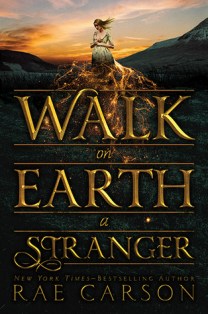
Book Review: Walk on Earth a Stranger by Rae Carson

September 22, 2015

Title: Walk on Earth a Stranger

Author: Rae Carson

Series: The Gold Seer Trilogy #1

Genre: Teen Fantasy [ish]

Rating: 4/5 stars

The Overview: Lee Westfall has a strong, loving family. She has a home she loves and a loyal steed. She has a best friend—who might want to be something more. She also has a secret. Lee can sense gold in the world around her. Veins deep in the earth. Small nuggets in a stream. Even gold dust caught underneath a fingernail. She has kept her family safe and able to buy provisions, even through the harshest winters. But what would someone do to control a girl with that kind of power? A person might murder for it. When everything Lee holds dear is ripped away, she flees west to California—where gold has just been discovered. Perhaps this will be the one place a magical girl can be herself. If she survives the journey.

The Review:

As Rae Carson is responsible for my favorite Young Adult book of all-time, “The Girl of Fire and Thorns,” I knew I had to read everything she published next. “Walk on Earth a Stranger” had all of the elements I loved from her first series: excellent characters, fantastic settings, and immersive writing that draws you in completely. While “Girl of Fire and Thorns” will always sit on a pedestal for me, this first book in the “Gold Seer” trilogy gave it a good run.

My favorite thing about this writer is how she develops and crafts her main characters. In a market inundated with female leads who start out already good at everything, Carson’s heroines are anything but typical. It’s refreshing because these girls (Elise for “Girl of Fire and Thorns” and Lee for “Walk on Earth a Stranger”) are so much more relatable. They have flaws and insecurities like the rest of us, and experiencing how they cope with different trials celebrates their inner strength and fortitude and inspires me to overcome my own obstacles. Both leading ladies have magic, but it’s always their strength of character that gets them through the day. My favorite things about Lee in this novel are her resourcefulness and ability to make the best of some very tough situations.

Great characterization aside, another thing “Walk on Earth a Stranger” has going for it is the setting. This historical landscape immerses you in early America when the California/Oregon Gold Rush began drawing people west by the thousands. Not only was it interesting to read what came across as a well-researched timepiece, but it also made me incredibly nostalgic about things from my childhood (most notably “Little House on the Prairie” and that old “Oregon Trail” computer game I used to play in grade school… does anybody else remember that?), but represented in an edgier fashion.

I have to admit historical fiction is not my genre of choice, and even though “Walk on Earth a Stranger” had a few fantasy elements, they were nowhere near as integral to the plot as I would have liked. Well, perhaps the elements were indeed integral, they just weren’t always at the forefront. For that reason, I wouldn’t recommend this book with fantasy as a main selling point. Genre aside, at the end of the day it was still an engaging story that will have you clamoring for the next one (coming out September 27, 2016):

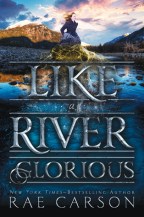
like a river glorious by rae carsonTitle: Like a River Glorious (Gold Seer #2) 

The Overview: After a harrowing journey across the country, Leah Westfall and her friends have finally arrived in California and are ready to make their fortunes in the Gold Rush. Lee has a special advantage over the other new arrivals in California—she has the ability to sense gold, a secret known only by her handsome best friend Jefferson and her murdering uncle Hiram. Lee and her friends have the chance to be the most prosperous settlers in California, but Hiram hasn’t given up trying to control Lee and her power. Sabotage and kidnapping are the least of what he’ll do to make sure Lee is his own. His mine is the deepest and darkest in the territory, and there Lee learns the full extent of her magical gift, the worst of her uncle, and the true strength of her friendships. To save everyone, she vows to destroy her uncle and the empire he is building—even at the cost of her own freedom.

Other books you might like:

by Niki Hawkes