Image

Book Review: Iron Crowned by Richelle Mead

3Title: Iron Crowned

Author: Richelle Mead

Series: Dark Swan #3

Rating: (4.5/5 stars)

The Overview:

The Review:

I’m sure at this point you’re all tired of hearing me gush about Richelle Mead, but I just can’t help it. Everything she does winds up on my favorites list, and the “Dark Swan” series is no exception. Although book #3 was a tad slow to start, it soon launched into an event-filled story with plenty of action, love, and humor. The momentum it gained near the end had me cancelling plans simply so I could sit down and finish it (sad, but true).

As mentioned before in my review of “Bloodlines” (book 1 in a different series), Mead’s writing style is always incredibly character-driven. What I love about this series is that it also has a great deal of action and world-building to go along with the first-person style. I would actually say the world-building is my favorite element. We get to spend a lot of time exploring the lands, customs, and people of the Otherworld (the land of the gentry, or fey) while simultaneously learning more about the paranormal qualities of our own world.

Overall, this is a series I consider well-worth reading, especially if you’re already a fan of the urban fantasy genre. Fair warning: proceed with caution if you are adverse to language and sexuality.

Other books you might like:

  • “Dead Witch Walking” by Kim Harrison
  • “Stray” by Rachel Vincent
  • “Moon Called” by Patricia Briggs
  • “Dead Until Dark” by Charlaine Harris
  • “Magic to the Bone” by Devon Monk
  • “Ill Wind” by Rachel Caine

by Niki Hawkes

Image

Book Review: The Eye of the World by Robert Jordan

Title: The Eye the World

Author: Robert Jordan

Series: Wheel of Time #1

Genre: Fantasy

Rating: 3.5/5 stars

The Overview: The Wheel of Time turns and Ages come and go, leaving memories that become legend. Legend fades to myth, and even myth is long forgotten when the Age that gave it birth returns again. In the Third Age, an Age of Prophecy, the World and Time themselves hang in the balance. What was, what will be, and what is, may yet fall under the Shadow.

The Review:

I would like to start out by saying: don’t let my conservative rating scare you off from this series. At least 75% of customers I talk to about fantasy rank this series in their top 3, if not their #1. I am definitely the minority here, as the book didn’t even make my top 20.

Don’t get me wrong, it’s still a classic that deserves its place as one of the all-time fantasy greats, it just happened to have some elements that I personally didn’t care for. As the beginning of an epic quest not unlike that of Tolkien, I found it a bit long-winded. Not boring, mind you, as there were several highly developed and exciting characters (who were frankly the biggest reasons why I’m tempted to read the second book). The magic system and overall measure of time were also highly original and interesting, even though we didn’t get to learn much about them.

No, what the book lacked is that sense of excitement I usually feel while reading a great fantasy novel. I believe this is due to poor pacing decisions rather than any issues with the plot. It was just too slow-moving with too many senseless encounters. There also wasn’t much of an arc, lacking the sort of emotional highs and lows that usually go along with good storytelling. I definitely would’ve appreciated more time spent on the climax of the book rather than endless chapters of the characters meeting one fat innkeeper after another. I guess I just missed that emotional payoff – I suppose I’ll have to evaluate the series as a whole for that kind of reaction.

Overall, I respect this author a great deal, as I believe he has done wonders for the fantasy genre by inspiring new authors every day. There are just too many out there that I enjoyed more.

Other books I liked better (in a particular order):

by Niki Hawkes

Image

Book Review: Jhereg by Steven Brust

Title: Jhereg

Author: Steven Brust

Series: Vlad Taltos #1

Genre: Fantasy

Rating: 4/5 stars

The Overview: The first to be published, this is actually the fourth novel in the timeline of the VLAD TALTOS series. The books recount the adventures of the wisecracking hired killer Vlad, a human on a planet mainly inhabited by the long-lived, extremely tall sorcerers known as the Dragaerans. One of the most powerful bosses in the Jhereg–Dragaera’s premier criminal organization–hires Vlad, one of their guild members, to assassinate Mellar, who stole millions from the Jhereg leadership and fled. Unfortunately, this thief turns out to be protected in a way that makes it difficult for Vlad to do his job without gaining the permanent enmity of a friend. The reader also learns more about Vlad’s past in this, and in other, lives.

The Review:

Jhereg was nothing like I thought it would be… it was better! I was expecting a typical “boy gets a dragons and goes out on an epic adventure” book (I guess I need to stop judging by the cover alone). What I ended up with was a cheeky, magical, modern-day assassin mystery that blew my socks off.

Highly interesting characters and plot-lines, it was an extremely fast-paced novel that keeps you page-turning to the very end. And when I say fast-paced, I’m not joking around. The author has an incredible “no words wasted” writing style that makes for an exciting read. Trouble is, if you blink or get distracted for even a moment (as I am wont to do) you’ll likely miss something important and plot-advancing – so stay focused!

Initially, I thought a draw-back to this series was the lack of attention on setting. I couldn’t tell if the book was taking place in a complete fantasy world or just in a twist of our modern-day (and actually, I’m still not sure). I initially thought the author was lazy, but now I’m starting to suspect he’s a bit brilliant. His overall mastery over other elements of the craft is what clued me in. You see, the story is written in a strong first-person narrative – done well enough that I always felt totally immersed into the character. I now think the reason the reader doesn’t get to see the settings clearer is that the main character doesn’t pay much attention to such commonplace (for him) details. If this is truly the case, the Brust did an excellent job sticking to his chosen perspective, and I applaud him on it.

Overall, it was a unique read that I wish I’d picked up years ago. The author has a good fusion of fantasy and mystery that really maintained my attention. Though not the first book chronologically, it is the first book according to the publisher, and that’s good enough for me (especially since the author admitted he has no clue in what order his books should be read).

by Niki Hawkes

Other books you might like:

  • “Dragon Weather” by Lawrence Watt-Evans
  • “The Thief’s Gamble” by Juliet E. Mckenna
  • “Mistborn” by Brandon Sanderson
  • “Black Sun Rising” by C.S. Friedman
  • “Sword-Dancer” by Jennifer Roberson
Image

The Adamantine Palace by Stephen Deas

Title: The Adamantine Palace

Author: Stephen Deas

Series: Memory of Flames #1

Genre: Fantasy

Rating: N/A

The Overview: The Adamantine Palace lies at the centre of an empire that grew out of ashes. Once dragons ruled the world and man was little more than prey. Then a way of subduing the dragons through alchemy was discovered and now the dragons are bred to be little more than mounts for knights and highly valued tokens in the diplomatic power-players that underpin the rule of the competing aristocratic houses. The Empire has grown fat. And now one man wants it for himself. A man prepared to poison the king just as he has poisoned his own father. A man prepared to murder his lover and bed her daughter. A man fit to be king? But uknown to him there are flames on the way. A single dragon has gone missing. And even one dragon on the loose, unsubdued, returned to its full intelligence, its full fury, could spell disaster for the Empire. But because of the actions of one unscrupulous mercenary the rivals for the throne could soon be facing hundreds of dragons …Stephen Deas has written a fast moving and action-fuelled fantasy laced with irony, a razor sharp way with characters, dialogue to die for and dragons to die by.

 The Review:

Unfortunately, this was a book I didn’t finish, which bums me out because I’d been looking forward to reading it since I first laid eyes on it. I don’t usually write reviews for the books I didn’t care for, preferring instead to focus on the recommend-worthy titles. I decided to make an exception in this case because I believe there are a few people out there who would enjoy this book a lot more than I did.

‘The Adamantine Palace” was difficult for me to walk away from, as the storyline was actually quite interesting – it kept me trying for about 100 pages. I liked the world, I liked the plot, and I liked the dragons. What I didn’t care for was the writing style. There were times where it was just underdeveloped enough that it read like a draft rather than a finished product. The dialogue was also a bit weak. Everybody spoke with the same voice and there was little variation in tone. It was unfortunate because it made interesting characters come across one-note.

I’ve been in the book business long enough to know that just because I don’t care for a title doesn’t mean others wont. If you might be one of those people, the digital world we live in makes it easy for you to find out. Just go to www.bn.com and download a digital sample. After reading the first few pages, you’ll know if it works for you or not.

Other dragon books you might like:

  • “Dragon Weather” by Lawrence Watt-Evans
  • “Joust” by Mercedes Lackey
  • “Dragon Champion” by E.E. Knight
  • “The Last Dragonlord” by Joanne Bertin
  • “Dragonflight” by Anne McCaffrey

by Niki Hawkes

Image

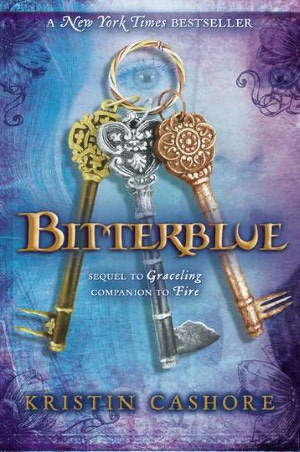
October’s Your Pick for Nik!: Bitterblue by Kristin Cashore

Title: Bitterblue

Author: Kristin Cashore

Series: Graceling Realm #3

Genre: Teen Fantasy

Rating: 3.5/5 stars

The Overview: Bitterblue is now queen of Monsea, still under the influence of her father Leck, a violent psychopath who altered minds. Her advisers want to pardon evildoers and forget everything, but she sees the past holds fast. Two thieves, who only steal what has been stolen, hold the truth and change her life. One, his Grace skill unidentified, has a key to her heart.

The Review:

“Bitterblue” was a good continuation in the Graceling saga. Even though it was told from Bitterblue’s perspective, Cashore did a great job progressing the stories of all the characters we fell in love with in the first novel – especially Katsa and Po. There were even elements of Fire that made an appearance, and I like the way both books were incorporated. The basic storyline was also good, and the element of mystery she added really helped build suspense.

There were, however a few things I found lacking. I loved “Graceling” for three reasons: the romantic love story, the adventure, and the creativity. I’m sad to say that “Bitterblue” left me wanting on two of the three. While the creative element is Cashore’s biggest strength, I don’t think she brought me the adventure or epic love story that I was hoping for.

Overall: Even though I liked the book, I wouldn’t recommend it for younger teens, as there were some seriously dark and twisted elements in the story that only made a slight appearance in the first two books. I actually think it was a big risk for Cashore to write such a sadistic villain, and the extremes to which she took him just might loose her some fans. It’s difficult to compare, but even when looking at villains in adult novels, this one was one of the worst, and not in an enjoyable “it’s just fiction” way, either. In any case, proceed with caution.

[Spoiler Alert! You might want to stop here if you haven’t read the book]

You picked it for me, now here’s the breakdown! I promised a thorough assessment, and that’s what you’re getting. :)

Plot: As I said before, I really enjoyed the fact that Po and Katsa’s story continued to a degree, even though they weren’t the stars of this book. Part of the reason why I loved the first book was the adventure Katsa goes on while running from Leck. I found that element somewhat lacking in this sequel. Even if the adventures had just been explorations of the city, I would’ve liked it better. As it was, you really only get to explore within the first few chapters, and that’s where the “adventure” ends. Unless, of course, you count the many times that she discovers things within her own castle – which brings me to my next point:

For someone as bored as Bitterblue, she sure doesn’t know a lot about her own home. You would think that spending 18 years in a place would get you rather acclimated, even if it’s just being aware of certain features of your castle (much less visiting them). I mean, it wasn’t like she was buried under paperwork right away after Leck died. I thought it was just too much senseless discovery, especially since Leck’s rooms and all the hidden passages provided plenty of “new” and interesting places for her to unveil. There was even a part where she met her dressmaker for the first time… it was odd.

The other aspect that I was the most disappointed in was the love interest. Graceling is still one of the most evoking romantic teen books I’ve ever read, yet I failed to find any of those qualities in “Bitterblue”. Heck, even “Fire” had a more compelling love story. I understand the basic appeal to Saf, as he’s got that element of danger and excitement going for him, but I was frankly more attracted to either Giddon or Teddy because they were actually, you know, nice to her. Bitterblue and Saf’s relationship just felt cheap to me. One kiss throughout a bulk of the book, then a sex scene right after she faces the trauma of watching Thiel kill himself… how romantic. “Bitter” and “blue” are good ways to describe how I feel wishing the story had gone a different route.

Characters: Cashore’s characters are always memorable, and I loved that she brought back Katsa and Po and gave them well-rounded roles within the story. She certainly has a knack for introducing new people and they always made me want to know more about them, even minor ones. I also thought Bitterblue was a great protagonist. She still felt like the little girl we met in “Graceling” but more mature, and I enjoyed watching her grow as both a young queen and a woman. If nothing else, she was consistent as a character throughout, and I liked the naive charm with which she faces the world. I would also like to note that the character I found most fascinating was Death. Not only did he have a cool grace, but it was implemented in a couple of creative ways, from memorizing books to learning a new language from a dictionary.

Writing: Cashore has a good flow to her works, and I don’t remember any passages or dialogues that felt forced. She’s got a concise way of introducing events and characters that I always struggle with in writing. She always brought a new character into the scene by giving them something memorable, whether it be by their grace, as with Fox, or their physical features or mannerisms as with Saf and Teddy. She also used a really good technique for delivering information to the reader without “dumping” it. The best example is the Questions game Saf plays with “Sparks” at the beginning of the book where we find out a lot of back-history in a conversational format.

The creative element was also impressive. The graces were diverse and interesting, and I thought she did a good job describing cyphers and integrating them into the story (I want to know who took all the time to design those charts). Cashore was also quite good at creating elements of mystery to the story: things that keep you turning the page. This is why I don’t think she needed Bitterblue to be ignorant of her castle; there were plenty of other things for her to discover along the way without that element.

Overall: I feel like a harsh critic, but my overall opinion of the book was a positive one. It was fun to read, and that factor alone gets it at least 2 stars. I learned some writing techniques that I’ll likely be using in my own works, and appreciated the expansion to Po and Katsa’s story.

Now Let’s Discuss!

I swear I haven’t been this hyper-critical of a book since high school book reports – haha! In any case, I had a lot of fun composing this review, but I’m most looking forward to hearing what YOU think. Do you agree or disagree with my assessments and why? What elements of the book worked for you? Did you find the story compelling?

by Niki Hawkes

Image

Book Review: Redwall by Brian Jacques

Title: Redwall

Author: Brian Jacques

Series: Redwall #1

Genre: Young Adult

Rating: 5/5 stars!

The Overview: Redwall Abbey, tranquil home to a community of peace-loving mice is threatened by Cluny the Scourge – the evil-one-eyed rat warlord – and his battle-hardened horde of predators. Cluny is certain that Redwall will fall easily to his fearsome army but he hasn’t bargained for the courage and strength of the combined forces of the Redwall mice and their loyal woodland friends. . . . .

The Review:

If I could say one thing about Jacques, it’s that he was a master storyteller! His books take you on grand adventures that rival the best fantasy novels out there. I’ve read them so many times the covers are falling off! An what’s more, the series sustains itself, with drawn out stories about downright fascinating characters. Bravery and Goodness can come from anywhere, and there are always evil-doers to stand up to. They are such well-rounded stories that I recommend them to even you hardcore fatasy buffs out there. They are often overlooked because people are expecting them to be like “Watership Down” or “Animal Farm”, and while those are worthwhile books in a certian context and place, they do not make for happy fantasy reading like these books do.

Redwall will make you forget you’re reading about animals. They boast creatively awesome representatives of different races. For example, mice are the humans of this world, sort of the standard by which we measure everyone else. The rabbits are the comic relief, and always put off a dwarf-like sentiment. The otters are the graceful archers, and very elf-like in their mannerisms. Even the villians are special – with rats as the cannon fodder and henchmen (orcs) and other creatures such as foxes and weasels who plot against our heroes.

All in all, I can credit this series for sparking my interest in books when I was in the fifth grade. I saw one in the library, and started reading smaller books with the hopes of working my way up to one someday. These are excellent adventures for children, and I’m a living example that they encourage literacy at young ages. As an adult I still love them, and am long overdue for another reread!

Word of warning: do not read these books if you are hungry… you’ll see.

by Niki Hawkes