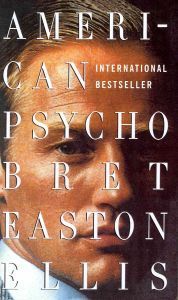
Title: American Psycho
Author: Bret Easton Ellis
Series: N/A
Genre: Horror
Rating: 3.5/5 stars
The Overview: Patrick Bateman is twenty-six and works on Wall Street. He is handsome, sophisticated, charming and intelligent. He is also a psychopath. Taking us to head-on collision with America’s greatest dream—and its worst nightmare—American Psycho is a bleak, bitter, black comedy about a world we all recognize but do not wish to confront. –Goodreads
Dave’s Review:
American Psycho is a well-written novel with plenty of merits, but it is also an exceptionally difficult book to actually like. Bret Easton Ellis takes us inside the mind of Patrick Bateman, a wealthy, successful, and thoroughly disturbed psychopath, and keeps us there for the entire book. The result is an often fascinating, frequently disturbing, and sometimes surprisingly tedious reading experience.
Much of the novel is an exercise in excess. Ellis devotes enormous amounts of attention to designer clothing, expensive accessories, restaurants, reservations, and the seemingly endless negotiations over who is going where for dinner and who gets invited. There is a lengthy chapter devoted to Whitney Houston’s music, followed by an even longer one later about Huey Lewis and the News. At one point, we get a painstaking account of virtually every repetition in every set of Bateman’s workout. And then there are the Donald Trump references. I suspect there are more mentions of Trump in this book than in an entire week of today’s mainstream media coverage.
All of this is presumably part of the satire, and there is a point to the relentless focus on status, consumption, celebrity, and superficial appearances. Bateman and his social circle inhabit a world in which designer labels and restaurant reservations
matter more than anything resembling genuine human connection. The repetition helps convey the emptiness and absurdity of that world, but understanding the intention does not necessarily make it enjoyable to read. I found myself wondering how much of this detail was necessary to make the point.
In some respects, the experience reminded me of George R.R. Martin’s seemingly endless descriptions of food or the relentless catalog of 1980s pop culture references in Ready Player One. Perhaps Ellis deserves some credit for inspiring a literary tradition of excessively detailed lists, although I doubt either Martin or Ernest Cline would necessarily appreciate the comparison.
Of course, the mundane excesses are only part of what makes the book challenging. The novel also contains extraordinarily graphic and disturbing violence, often described in excruciating detail. It is difficult to say which is more off-putting: the seemingly endless descriptions of trivialities or the horrifying accounts of Bateman’s brutality. Neither makes for particularly comfortable reading.
I saw the film adaptation of American Psycho decades ago, and while my memories are now pretty hazy, I do remember two things distinctly: the extreme violence and the scene in which Bateman and his colleagues try to outdo one another with their business cards. That scene is also in the novel, and it perfectly captures the absurdly dark humor that runs throughout the book. The fact that these supposedly successful, sophisticated men can become so consumed by something as trivial as the quality of their business cards is both hilarious and disturbing.
I appreciate what Ellis is attempting to accomplish, and there is no denying the novel’s skill, ambition, or satirical bite. However, it frequently tested my patience, and at times I found it something of a chore to get through. Its disturbing perspective and relentless excess make it memorable, but also exhausting. A worthwhile and thought-provoking novel, perhaps, but not one I can say I particularly liked.

