Image

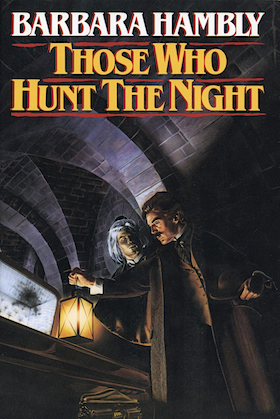
Book Review: Those Who Hunt the Night by Barbara Hambly

Title: Those Who Hunt the Night

Author: Barbara Hambly

Series: James Asher #1

Genre: Horror

Rating: 3.5/5 stars

The Overview: At the turn of the twentieth century, a former spy is called into service to hunt down a vampire killer… Once a spy for Queen Victoria, James Asher has fought for Britain on every continent, using his quick wits to protect the Empire at all costs. After years of grueling service, he marries and retires to a simple academic’s life at Oxford. But his peace is shattered one night with the arrival of a Spanish vampire named Don Simon. Don Simon can disappear into fog, move faster than the eye can see, and immobilize Asher—and his young bride—with a wave of his hand. Asher is at his mercy, and has no choice but to give his help. Because someone is killing the vampires of London, and James Asher must find out who—before he becomes a victim himself. –Goodreads


Dave’s Review:

Barbara Hambly’s Those Who Hunt the Night is an enjoyable blend of gothic horror and mystery that brings to mind Bram Stoker’s Dracula. It is also notable as the first winner of the Locus Award for Best Horror Novel. Set in Victorian England, it captures much of the atmosphere and tone of Stoker’s classic, with its dark secrets, unsettling encounters, and genuinely frightening vampires. However, Hambly takes the concept in a somewhat different direction, giving readers a closer look at vampire society and a more human-like perspective on these creatures.

Unlike the increasingly glamorized and romanticized vampires that have become popular in more recent fiction, Hambly does not lose sight of what makes vampires frightening. They may have understandable motivations, personalities, and even recognizable human qualities, but they remain dangerous and unsettling. This balance between their more relatable characteristics and their fundamentally monstrous nature is one of the novel’s strengths.

Another feature that distinguishes the novel is its structure. Rather than relying primarily on the traditional conventions of gothic horror, Hambly approaches the story as a mystery investigation. The plot unfolds through the gathering of clues, questioning of suspects, and gradual uncovering of secrets. This gives the novel a different feel from Stoker’s book, even while retaining much of its atmosphere and sensibility.

I found Those Who Hunt the Night to be an entertaining and refreshing take on vampire fiction. It may not be particularly groundbreaking, and some aspects of the story are more engaging than others, but the combination of Victorian mystery and traditional gothic horror works quite well. For readers who enjoy vampires portrayed as genuinely dangerous creatures rather than romantic figures, this is certainly worth a look.
Image

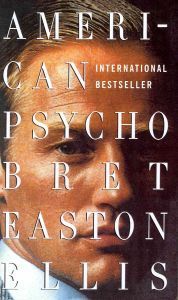
Book Review: American Psycho by Bret Easton Ellis

Title: American Psycho

Author: Bret Easton Ellis

Series: N/A

Genre: Horror

Rating: 3.5/5 stars

The Overview: Patrick Bateman is twenty-six and works on Wall Street. He is handsome, sophisticated, charming and intelligent. He is also a psychopath. Taking us to head-on collision with America’s greatest dream—and its worst nightmare—American Psycho is a bleak, bitter, black comedy about a world we all recognize but do not wish to confront. –Goodreads


Dave’s Review:

American Psycho is a well-written novel with plenty of merits, but it is also an exceptionally difficult book to actually like. Bret Easton Ellis takes us inside the mind of Patrick Bateman, a wealthy, successful, and thoroughly disturbed psychopath, and keeps us there for the entire book. The result is an often fascinating, frequently disturbing, and sometimes surprisingly tedious reading experience.

Much of the novel is an exercise in excess. Ellis devotes enormous amounts of attention to designer clothing, expensive accessories, restaurants, reservations, and the seemingly endless negotiations over who is going where for dinner and who gets invited. There is a lengthy chapter devoted to Whitney Houston’s music, followed by an even longer one later about Huey Lewis and the News. At one point, we get a painstaking account of virtually every repetition in every set of Bateman’s workout. And then there are the Donald Trump references. I suspect there are more mentions of Trump in this book than in an entire week of today’s mainstream media coverage.

All of this is presumably part of the satire, and there is a point to the relentless focus on status, consumption, celebrity, and superficial appearances. Bateman and his social circle inhabit a world in which designer labels and restaurant reservations
matter more than anything resembling genuine human connection. The repetition helps convey the emptiness and absurdity of that world, but understanding the intention does not necessarily make it enjoyable to read. I found myself wondering how much of this detail was necessary to make the point.

In some respects, the experience reminded me of George R.R. Martin’s seemingly endless descriptions of food or the relentless catalog of 1980s pop culture references in Ready Player One. Perhaps Ellis deserves some credit for inspiring a literary tradition of excessively detailed lists, although I doubt either Martin or Ernest Cline would necessarily appreciate the comparison.

Of course, the mundane excesses are only part of what makes the book challenging. The novel also contains extraordinarily graphic and disturbing violence, often described in excruciating detail. It is difficult to say which is more off-putting: the seemingly endless descriptions of trivialities or the horrifying accounts of Bateman’s brutality. Neither makes for particularly comfortable reading.

I saw the film adaptation of American Psycho decades ago, and while my memories are now pretty hazy, I do remember two things distinctly: the extreme violence and the scene in which Bateman and his colleagues try to outdo one another with their business cards. That scene is also in the novel, and it perfectly captures the absurdly dark humor that runs throughout the book. The fact that these supposedly successful, sophisticated men can become so consumed by something as trivial as the quality of their business cards is both hilarious and disturbing.

I appreciate what Ellis is attempting to accomplish, and there is no denying the novel’s skill, ambition, or satirical bite. However, it frequently tested my patience, and at times I found it something of a chore to get through. Its disturbing perspective and relentless excess make it memorable, but also exhausting. A worthwhile and thought-provoking novel, perhaps, but not one I can say I particularly liked.