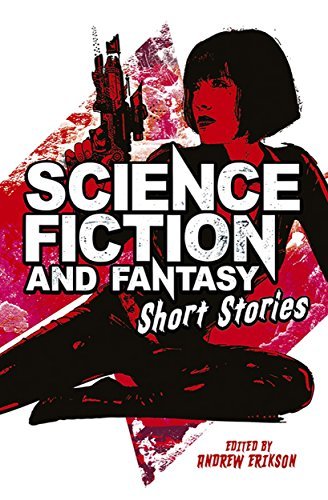
Title: Science Fiction and Fantasy Short Stories
Author: Andrew Erikson (editor)
Series: N/A
Genre: Science Fiction
Rating: 2.5/5 stars
The Overview: Science fiction and fantasy have gone hand-in-hand since their emergence at the end of the 19th century. Containing the best short stories of the masters of the two genres, this collection brings together the outstanding imaginations of writers such as H. G. Wells, George Griffith, Robert E. Howard and William Morris. Providing both an escape from the troubles of the real world and unique insight, these tales provide an experience that can’t be replicated anywhere else. –Goodreads
Dave’s Review:
This compilation is an journey through the early history of science fiction and fantasy, but I found the quality to be uneven. Some stories, particularly the H.G. Wells and Ambrose Bierce selections, remain interesting because of their ideas and the historical context in which they were written. Others are little more than pulpy adventures that feel dated today. I appreciated seeing how authors from the late nineteenth and early twentieth centuries imagined technology, space travel, and alternate realities, but too many of the stories were overly wordy, meandering, or simply failed to go anywhere particularly interesting. There are some worthwhile curiosities here, but overall I found the collection more interesting historically than enjoyable as a reading experience today.
As usual with short story collections, I noted my thoughts in a couple of sentences after reading each one, and have compiled them below.
Under the Knife by H.G. Wells. A story about a man undergoing an operation, yet is able to perceive what is happening on both a small scale and large scale via an outer body experience. Interesting for a story written in the 19th century. No doubt it was terrifying going into an operation back then, with a very high mortality rate, especially for anything major.
The Door in the Wall by H.G. Wells. This one is about a door to some sort of alternate reality where life is simple and peaceful. It definitely seems to be a metaphor for different paths in life and making decisions.
Polaris of the Snows by Charles B. Stilson. I was not familiar with the author prior to reading this story. It is a fun, pulpy adventure story that takes place in the Arctic – perhaps somewhat of a polar Tarzan. This was nothing special, just a fun read.
The Artist of the Beautiful by Nathaniel Hawthorne. I have not read Hawthorne since The Scarlet Letter in high school. This story had promise at the beginning, but ultimately did not go in the direction that I thought it might. However, that is probably not unusual for speculative fiction from so long ago. It was also overly wordy and meandering in a few places, but likely just the style of the author/times.
The Darwinian Schooner by W.L. Alden. An interesting idea of a story about a schooner found at sea, but ultimately I felt that it never went anywhere very satisfying. There was potential for a deeper story. Modern authors likely would have taken this concept much further.
A Visit to the Moon by George Griffith. I cannot say that this was a particularly good story, but it was an interesting read due to its age. This was written in 1900, the same time as H.G. Wells’ serialized novel on the same topic. Some of the details seem quite ridiculous today, but it is fascinating to see how some authors envisioned such a trip the better part of a century prior to when it occurred in reality.
Moxon’s Master by Ambrose Bierce. This starts out with “do you really believe that a machine thinks?” No doubt this was a wild statement in the late 1800s, but with AI prevalent everywhere today, it hardly raises an eyebrow. However, this was an interesting relic of a bygone era, complete with outdated perceptions of technology. And the ending, well, still very much relevant in our world today.
Rats in the Belfry by John York Cabot. An eccentric man builds a bizarre mansion and then discovers a portal. This is perhaps a simple precursor to other similar works that have since presented much more expansive ideas based on this concept. Still, this brief story was worth the small investment.
On the Martian Way by Harry Gore Bishop. I was surprised to discover afterward that this was first published in 1907, before the Titanic. I would have guessed that it took some inspiration from that event. Overall it is an average story, with some interesting insight into what we would now say is a pretty archaic view on how “shipping” routes between colonies on different planets might look.
Within an Ace of the End of the World by Robert Barr. This is a story where a world food shortage occurs at the dawn of the twentieth century. It is discovered that food can be manufactured from nitrogen in the air, but of course that then causes other problems. It was written in 1900, and is a bit bland, but it is an early attempt at tackling certain topics which are still pretty relevant today.
The Phoenix on the Sword by Robert E. Howard. A Conan story. I have read a couple of Conan novels long ago. I am not a huge fan. This is more or less what I expected, but at least in short form, it is less of a commitment. It is mildly entertaining, but there is zero depth and it suffers from some very dated tropes that feel a little uncomfortable today.
The Tower of the Elephant by Robert E. Howard. Another Conan story, this one is about a young Conan attempting to steal an artifact from a guarded tower. Again, it is purely an adventure story from another era. It is a good bit of fun with the right expectations, but it lacks any depth. This one is probably slightly more memorable than the previous Conan story in this collection.
The Shadow Kingdom by Robert E. Howard. This predates the Conan stories, and is apparently regarded as a highly influential work, considered to be one of the very first truly gritty sword and sorcery story. Be that as it may, I did not find the story particularly interesting or enjoyable to read. It feels pretentious and needlessly excessive. I guess I can at least say that I have read it now?
The Sea-Witch by Nictzin Dyalhis. I was completely unfamiliar with this author, and perhaps if would have been best left that way. This was an overly long and largely uninteresting story about, well, a witch? It is Viking-inspired, but quite pulpy and I got very little out of it for the time I invested in reading it.
The Dancer in the Crystal by Francis Flagg. This story imagines a scenario where electricity becomes nullified. Despite the strong premise, the story itself is a little underwhelming. Written in 1929 and taking place in the 1950s, the effect of the complete loss of electricity in the story is actually nowhere near as catastrophic as it would be were this to occur in our world today.
The Regent of the North by Kenneth Morris. Cool, a Viking story! Except that I found it to be very mundane. It felt like reading a history book with elegant prose. This style of short story is just so different from what tends to be popular today.
The Folk of the Mountain Door by William Morris. A Nordic tale that was supposedly an influence on early twentieth century fantasy authors. That may be the case, but I did not enjoy reading it. The prose is strong, but archaic, and the text has far too many poems/songs for my liking. I also found the story itself to be pretty unmemorable.

