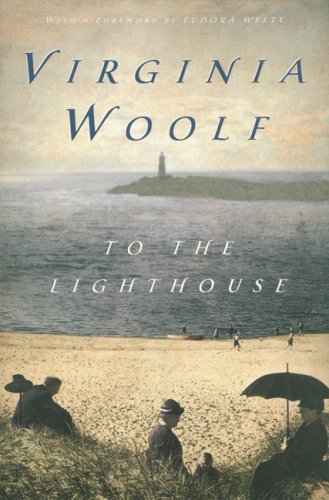
Title: To the Lighthouse
Author: Virginia Woolf
Series: N/A
Genre: Literary Fiction
Rating: 3/5 stars
The Overview: The serene and maternal Mrs. Ramsay, the tragic yet absurd Mr. Ramsay, and their children and assorted guests are on holiday on the Isle of Skye. From the seemingly trivial postponement of a visit to a nearby lighthouse, Woolf constructs a remarkable, moving examination of the complex tensions and allegiances of family life and the conflict between men and women. As time winds its way through their lives, the Ramsays face, alone and simultaneously, the greatest of human challenges and its greatest triumph—the human capacity for change. –Goodreads
Dave’s Review:
Virginia Woolf’s To the Lighthouse is widely considered to be a pinnacle of twentieth-century literature. Its deep symbolism, introspective style, and philosophical musings about the passage of time and life serve as a wealth of material for study and discussion. That said, I found it much easier to appreciate than to actually enjoy.
Anyone expecting a conventional narrative will almost certainly struggle, as I did. There is very little in the way of plot, with the author instead focusing largely on the inner thoughts and shifting perspectives of her characters. While this stream-of-consciousness approach has merit, it comes at the expense of momentum. Long portions of the novel feel more like introspection than storytelling. The pacing is glacial, and I was frequently waiting, hoping, for something interesting to happen.
The characters likewise failed to engage me. Woolf spends much time in the minds of a number of them, but the style renders them largely indistinct and unmemorable. They blend together, making it difficult to relate closely or to form a real attachment to any one individual. At this point, a couple of weeks after having finished the book, very few of the characters left any lasting impression on me. They really function merely as mouthpieces (mind pieces?) for the author’s ideas, a choice which often caused me to struggle with engagement.
Despite these frustrations, the book succeeds at what I believe it is intended to do – that is to ruminate on the passage of time and life. The lighthouse can be seen as a symbol of long-term goals, and the many ways that they shape our lives as we aspire to achieve them. It is certainly symbolic of a plethora of other things that attentive readers will pick up on as well, given some patience. Woolf is clearly a strong writer, being almost poetic at times. The density and style do at times require a careful analysis, similar to that of poetry, to extract some of the layered meaning. If I ever revisit this work in the future, I will be sure to do so at a point where I am prepared to devote the necessary time and focus.
I can certainly appreciate why To the Lighthouse is considered a masterpiece, even if it never connected with me on the level that was likely intended. It is a book whose ideas outlive the characters or story. I am glad to have read it, even though the journey was difficult and ultimately not as rewarding as I had hoped to find it.

